
Defence spending: a moral dilemma of our age

Many of us have supported the development of ethical investment strategies since the concept first became mainstream in the 1980s when firms such as Friends Provident promoted a new generation of ethical investment funds. Since then the concept has had various iterations and is now embedded in the Environment, Social and Governance (ESG) strategies of many major financial institutions.
Once, it was almost automatically assumed that spending on weapons had no place in an ethical or ESG investment strategy. Now, we must question that.
A group of Labour MPs have posed this question to our financial institutions in an open letter published in the Financial Times (below for those unable to access the FT’s content).
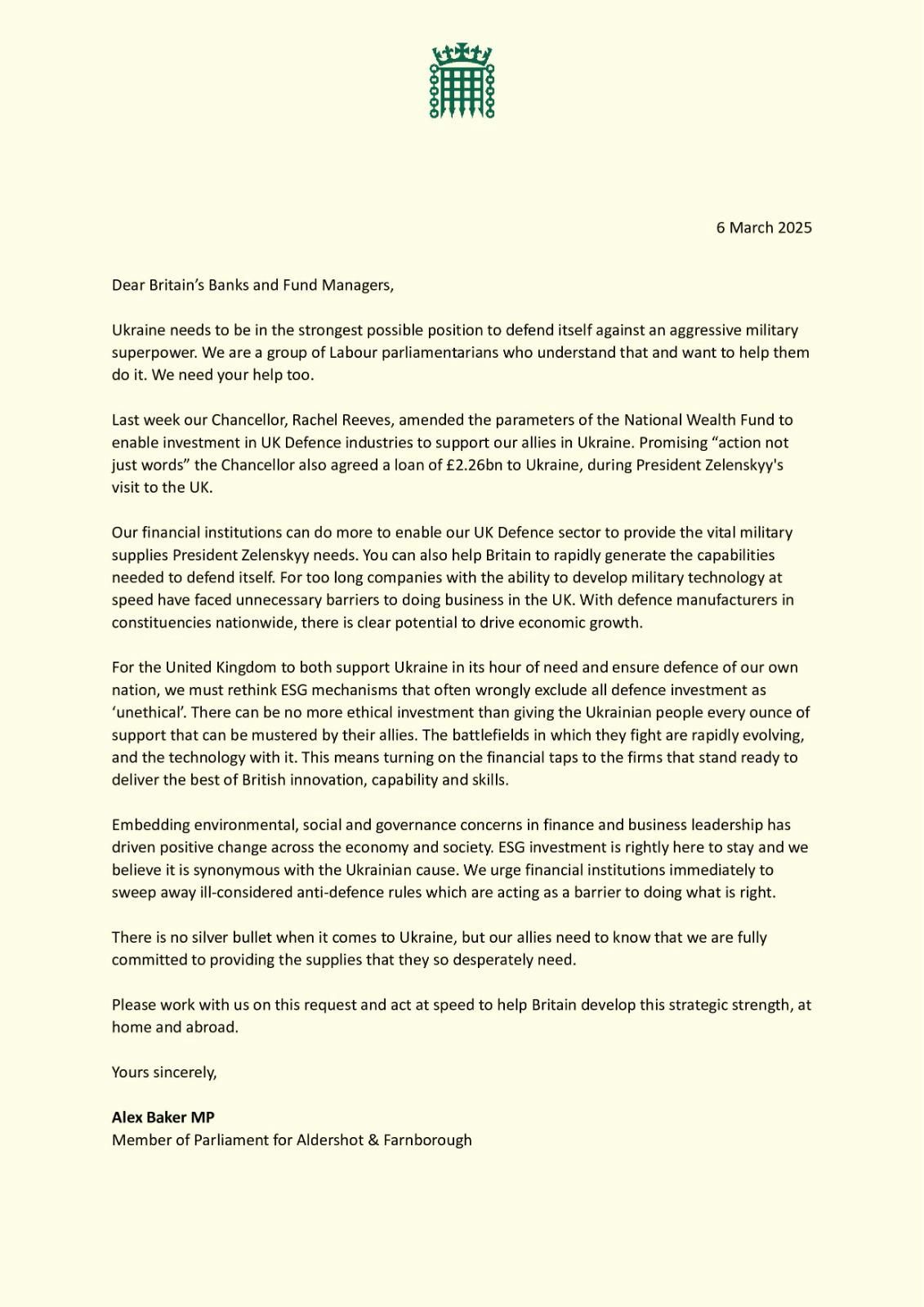
Their arguments are compelling, even though they make uncomfortable reading for those of us who hoped – and campaigned – for a more peaceful and safer world. Those hopes have been dashed. We now live in a more dangerous world, one where the threats to freedom, democracy, tolerance, prosperity and the rules-based international order are more acute than any time since the Second World War. Those threats are not theoretical or intellectual, they are violent, brutal and existential.
Sadly, force is going to have to be met with force if the values we so passionately hold are to be protected. No-one should take any pleasure in having to argue this.
What role for our nuclear weapons …?
Of course, this a complex issue. It will be about how we re-arm and where we find the money form. It also brings into the mix our nuclear weapons and the future of NATO.
Again, I find myself in a dilemma, at least on the question of nuclear weapons as I have long campaigned for their abolition. I find myself breathing a sigh of relief that ourselves and France still have a nuclear deterrent, although only France’s can be described as independent as the mistakes of the Thatcher government when replacing Polaris have made us too dependent on America.
One aspect I do find encouraging is the determination of Europe to take greater responsibility for its own security.
… and what role for NATO?
I have never been an enthusiastic Atlanticist. I thought back in the 1970s that a combined European Defence Force should be a key part of an expanding European Union to give Europe a chance of controlling its own destiny, liberated from dependence on the Americans. Then, through NATO, we were part of a world polarised between the West and the Soviet Union, the Russian Empire of its day. A third force (China wasn’t in the picture then) seemed to me to offer a better prospect of avoiding the tensions between the two great power blocks escalating into anything more serious.
Such was my dislike of NATO and distrust of the Americans that when the Liberal Party and the Social Democratic Party merged to create the Liberal Democrats in the late 1980s, I was one of a group of Liberals who opposed including mention of NATO in the preamble to the new party’s constitution, an argument we thankfully won. Europe now has to seize the chance to shape its own destiny, founded on the values previous generations fought for and sacrificed so much to defend. NATO has to become a partnership of two equals if it is to have any relevance in the future. We have to to ready to accept that the current US government may not be prepared to commit to that, reinforcing the need for Europe to move quickly and decisively, embracing UK Prime Minister Kier Starmer’s appeal to a”coalition of the willing”.
That will need huge financial resources which is why we must look to financial institutions to play their part by investing in those companies that are now needed to help re-arm us. If they do not, then what values embedded in the ‘Social’ part of ESG will be left?
 David Worsfold