

The sound, fury and partisan debate over the UK budget, American elections, Ukraine and the Middle East – just for starters – has drowned out some important comments about media freedom, journalism and artificial intelligence from the UK Prime Minister Kier Starmer.
Writing in The Guardian at the end of October, he managed to convey the right sentiments without actually making any firm commitments, a hallmark of his political style. Some of his comments seem to jar against what his government is doing – or not doing in some cases.

His comments on SLAPPs – Strategic Lawsuits Against Public Participation – epitomise this problem.
In his article, Starmer condemned the use of this legal strategy to “intimidate journalists away from their pursuit of the public interest”, adding that “Such behaviour is intolerable and we will tackle the use of SLAPPs to protect investigative journalism, alongside access to justice”.
Sounds all very fine until you put those remarks against those of his government’s justice minister in the House of Lords, Lord Ponsonby. He recently said the government could not commit to bringing standalone legislation on SLAPPs. Instead he promised a review.
You have to ask: why is a review necessary?
In the last Parliament the Labour MP for Caerphilly, Wayne David, put forward a Private Members Bill to deal with the outstanding issues surrounding SLAPPs. His bill was supported by the front benches of all parties but failed to make progress because of the unexpectedly early General Election. Mr David stood down at the election and no-one has picked up his well-crafted Bill.
There is no need for a review when there is already a Bill that Labour supported in opposition. It would extend the limited action against SLAPPs already contained in the Economic Crime and Corporate Transparency Act last year which only covered economic crime and was passed a year ago. It created a robust legal framework for removing this tactic from the arsenal of the rich, powerful and corrupt. Its scope just needs to be extended.
The pieces are already in place. In just needs the political will to pick them up and fashion them into legislative action.
No clarity on AI
There is a similar problem with the Prime Minister’s comments on artificial intelligence, especially the way big tech is stealing copyright material to train its AI platforms. In his desperation to make the UK welcoming to big tech, he has suggested that the owners of copyright material should have to opt out of allowing their content to be used, rather than retain full control over their work, putting them in a position to deal with big tech on a more equal footing and ensure fair payment for the use of original material.
This is one of many aspects of AI that will have a profound impact on how people source and access news. The established media has much to offer the AI world and many opportunities to use it positively but not if they are denied revenue that should be legitimately theirs.
Those of us in the media in the UK can take comfort from Prime Minister’s strong statements in favour of press freedom and the acknowledgment of the crucial role of independent journalism as one of the cornerstones of democratic society. That is worth having in a world where so many governments are turning against the media, seeking to supress and control it, often violently.

As the world holds it breath with the US Presidential election heading for its climax in a little over a week’s time, dark clouds are gathering over the once prized values of media freedom.
Just a week after Patrick Soon-Shiong, the billionaire owner of the Los Angeles Times, instructed the paper’s editorial board not to make an endorsement for president, Amazon founder Jeff Bezos, who owns the Washington Post, similarly stopped that paper offering an endorsement of any candidate. It is assumed that both papers would have endorsed the Democrat nominee Kamala Harris.
This unprecedented interference in editorial freedom has provoked a fierce backlash among journalists in the United States.
Mariel Garza, the editorials editor of the Los Angeles Times, resigned, making it very clear why she was taking a stand: “I am resigning because I want to make it clear that I am not okay with us being silent. In dangerous times, honest people need to stand up. This is how I’m standing up”, she told the Columbia Journalism Review.
Marty Baron, the former executive editor of the Washington Post, condemned that paper’s decision as “cowardice, with democracy as its casualty”.
He pointed the finger at the Republican candidate Donald Trump, saying that he will “see this as an invitation to further intimidate the owner” of the Washington Post. “Disturbing spinelessness at an institution famed for courage”, Baron added. Ironically, that statement was issued on X (formerly Twitter), now owned by another billionaire, Elon Musk, who has been busy spending millions of dollars buying votes for Trump.
Trump has long been an enemy of a free press, repeatedly labelling anything that is critical of him as “fake news” and throwing out baseless accusations about left-wing conspiracies against him.
He has frequently threatened to strip broadcast licences from the three biggest US television networks – ABC, CBS and NBC – in retribution for being fact-checked during the campaign and for news coverage that Trump claims is unfair.
“For the past decade, Donald Trump has been running a campaign against the media straight out of the playbook that authoritarians have used around the world, which is to threaten retaliation against news organizations if they don’t provide him with favourable enough coverage,” says Ian Bassin, an attorney and founder of the not-for-profit advocacy group Protect Democracy. “We are seeing now the seeds of that campaign bearing fruit.”
Trump has made it very clear during the campaign that, if elected, those who have opposed him will pay a heavy price. Bezos, Soon-Shiong (who owns a vast medical products business that needs government licences) and Musk have much to lose if they antagonise a vengeful Trump. But that is not how democracy works. That is not how a free press works.
The proud claim to be “The Land of the Free” is starting to look threadbare as its great press institutions are silenced. It will be left in tatters if Trump is elected.

The role that social media has played in promoting the far-right violence of the last week is now firmly in the spotlight. The number one culprit is X with its owner, Elon Musk, now adding his hate-filled bigotry to an already volatile mix.
I have not been convinced for some time that X adds much, if any, value to those seeking constructive engagement or wanting to promote good news about themselves, their business or their interests. Since Elon Musk took over Twitter and rebranded it, the quality and engagement on the platform has declined drastically. It has been clear that many of the organisations and people we once believed we could engage with through the platform have either left or stopped using it.
A year ago, I was already in despair at how Musk was wrecking a once vibrant, engaging platform – X marks the spot where Musk buried Twitter.
Having put considerable effort into my own and other organisations’ presence on the platform I have been reluctant to acknowledge the full extent of its decline. However, the last few months, and particularly the events of the last week, have now convinced me that the time has come to leave the platform.
During the General Election campaign it was swamped with lies, distortions and outright bigotry in the name of Reform. Much of that is what now gives cover to the violence of their far-right allies. It is straight out of the playbook that Trump uses in the US. His rhetoric and lies about the last Presidential election emboldened groups such as the Proud Boys to launch their assault on Capitol Hill. The same is now happening here and X is at the heart of it.
Musk himself has voiced the view that this is the start of civil war in our country, another narrative gathering force in the US. It will only get worse as the US elections approach and probably fuel further assaults on our institutions in the UK. It is no coincidence that the police have been as much a focus of the violence as immigrants and Muslims: they are seen as representing the state. There are too many uncomfortable parallels with the rise of the Nazis in Germany in the late 1920s and 1930s.
So, it is not merely that X no longer offers any value. It is being used to destabilise society and our institutions. I believe to remain on it is reputationally damaging to any decent individual or organisation.
It is time to go.
• For one last time, I will put a link to this post on X before deleting the account later today.
Don’t say it too loudly – at least in Liberal Democrat circles – but we might all be breathing a sigh of relief at the vagaries and distortions of our first-past-the-post electoral system come 5 July. Decades of campaigning for a switch to proportional representation have come to nothing. That failure might save us from seeing dozens of far-right Reform MPs elected.
It is ironic that those of us who believe we need a fairer electoral system are faced with the prospect of watching Reform claw its way up the opinion polls, possibly even overtaking the Tories to claim a marginal second place, and yet come out of the election with a handful of MPs at best. Just for once, it could be that the Liberal Democrats, aided by a ruthless strategy of targeting their best prospects, benefit from the distortions of the first past the post system.
With ten days to go plenty could happen, especially as we are in unchartered territory with the rise of Reform. We have seen dramatic collapses in the Tory vote in opinion polls in the run-up to General Elections before but on polling day many Tories find they cannot let go of mother’s apron strings. When the real votes are counted the collapse is rarely as bad as forecast. They may do well enough to fend off the threat of Reform overtaking them.
Whatever happens, we will be looking at the starkest proof yet that the first-past-the-post system is not fit for purpose. It simply doesn’t cope with an increasingly fragmented multi-party system.
The rise of Reform should not be an excuse for those of us who believe in a fairer electoral to diminish our commitment to see one put in place. We need to separate the two issues, although that is not easy right now.
A nightmare scenario
The nightmare for many of us will be if Nigel Farage gets elected with three or four others from his far right fan club and has a platform to constantly bleat about being the “real” leader of the opposition, regardless of how many more MPs the Tories, Liberal Democrats or SNP have.
The polls in Clacton apparently show that Labour is second to Reform. We certainly need other left of centre voters – Liberal Democrats and Greens – to swing behind Labour and hope that reasonable centrist Tories, who are almost politically homeless at the moment, realise they have to hold their noses and vote Labour to stop Farage.
This need for a broad progressive and centrist alliance to stop the rise of the far right has dawned on the French almost too late. When the dust settles on our General Election – and the French election – we are going to have to take stock of what has gone so wrong that millions of people are being seduced by the siren voices of evil.
We need a powerful narrative to combat this. Right now it is hard to see where it might come from.

The main UK party manifestos were launched this week amid much fanfare and hype but how much substance is there when it comes to policies on the media and press freedom?
Labour’s manifesto was carefully crafted to avoid too many specific policy commitments. When it comes to the media there is virtually nothing, apart from a token mention of protecting people from harm caused by social media. They are offering us few clues as to what they might do in this crucial area in government after 4 July, assuming the current opinion poll trends hold.
Gone are its previous commitments to implement Section 40 of the Crime and Courts Act. This was the post-Leveson proposal for a state-backed press regulator with the power to impose costs on media organisations that refused to join by allowing courts to award all costs against the media in cases even when they were successful. It was opposed by most major media organisations. The clause was repealed – without opposition from Labour – in the Media Act that was rushed through its final stages as Parliament was dissolved when the General Election was called.
The Liberal Democrats and the Greens remain committed to reviving the second part of the 2012 Leveson enquiry with the Liberal Democrats saying they “support independent, Leveson-compliant regulation”.
SLAPPS not forgetten entirely
The bill to extend the protection against SLAPPS (strategic lawsuits against public participation) to non-economic crime did not survive the legislative cull at dissolution. This was promoted by Labour backbencher Wayne David, who is not re-standing, and had attracted all-party support.
There is no mention of SLAPPS in the Labour manifesto, although Shadow Foreign Secretary David Lammy is on record during the campaign as saying a future Labour government would take further action to curtail the use of SLAPPS. The Liberal Democrats included a commitment to back anti-SLAPPS laws in their manifesto.
The Conservative manifesto contains the usual sabre-rattling at the BBC, saying it “should represent the perspectives of the entire nation with diversity of thought, accuracy and impartiality as its guiding principles. We will carefully consider the findings of the Funding Review ahead of the next Royal Charter and ensure it upholds these principles”.
The Green Party raised concerns about media ownership saying it would put forward measures to prevent any one company or person from owning more than a fifth of the media market.
Artificial intelligence looks to be in the ‘too hard’ tray
All the parties dance around the subject of artificial intelligence, especially the potential impact of large language models and generative AI on copyright and the quality of digital information.
Labour proposes a Regulatory Innovation Office, a sort of super-regulator that would ensure other regulators keep pace with changes in technology and market practice. It would have a brief that would stretch well beyond the media, taking in financial services among other highly regulated sectors.
The Liberal Democrats have more to say on the digital world than other parties, saying they “support modern and flexible patent, copyright and licensing rules” as part of a reform of copyright. They also propose increasing the Digital Services Tax paid by big tech firms from 2% to 6%
On misinformation, the party said it would push “for a global convention or treaty to combat disinformation and electoral interference, supplemented by an annual conference and Global Counter-Disinformation Fund”.
It also proposes a Digital Bill of Rights, which it says would cover rights to privacy, free expression, and participation and include powers to prevent harassment and abuse online.
The Conservatives can point to the Digital Markets Act, which was passed as Parliament was dissolved, with new powers to regulate big tech and create a new regulator – the Digital Markets Unit – which can compel tech companies to pay for news content which appears on their platforms and also fine them for abusing their market position.
Comes down to votes
The overall conclusion has to be that the policies on the media put forward by the main UK parties are patchy, perhaps surprisingly so given how much people discuss the press and media and how fast the worlds of news, information, artificial intelligence and social media are changing. It probably comes down to the first question parties ask themselves at election time when compiling their manifestos: “Are there any votes in it?”
• Reform UK has yet to produce a detailed manifesto and its website is pretty threadbare. It says it will publish a “Contract with the People” next week.
• Press Gazette has a more detailed review of the media policies of the main parties and additional commentary.

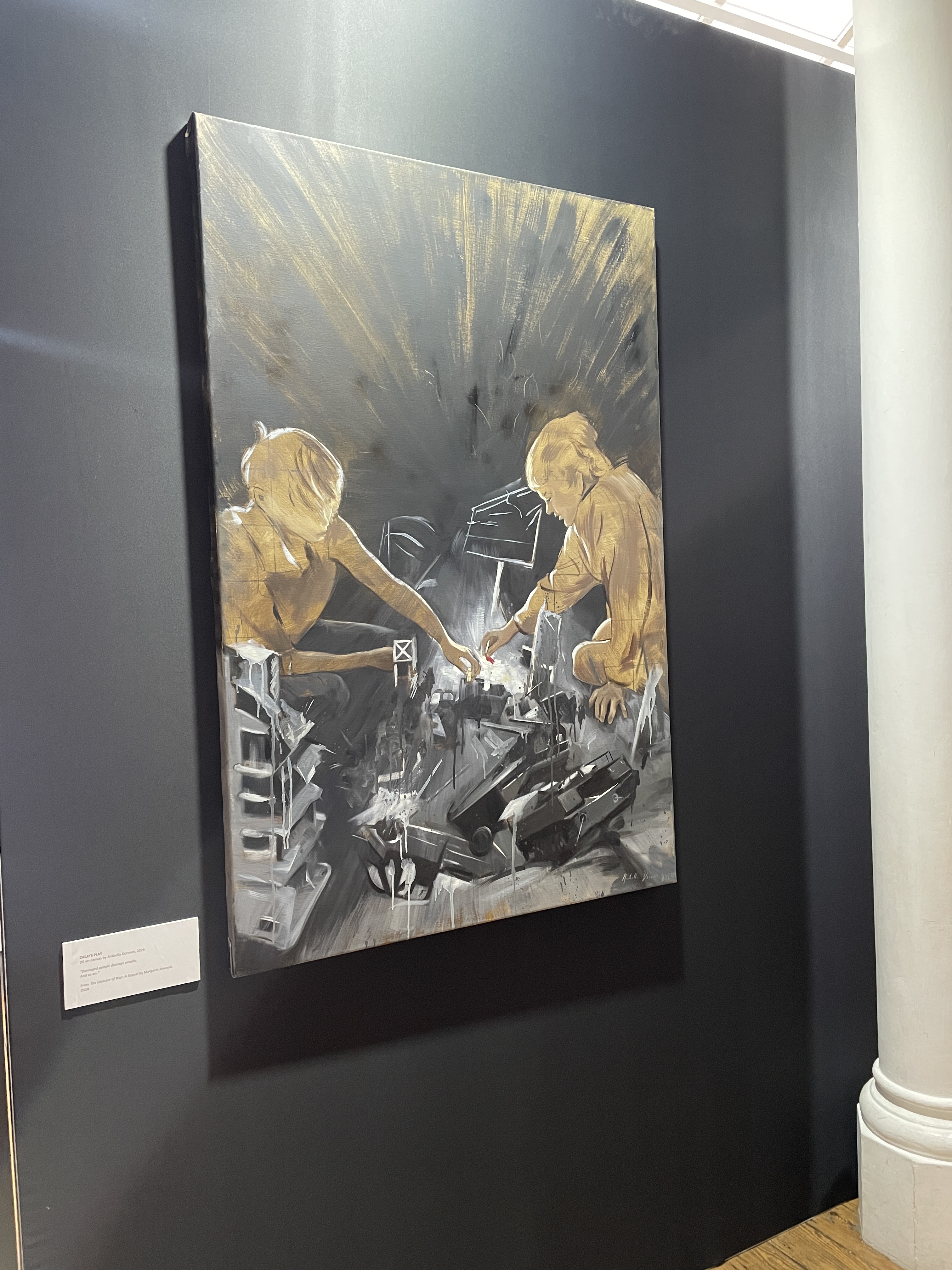
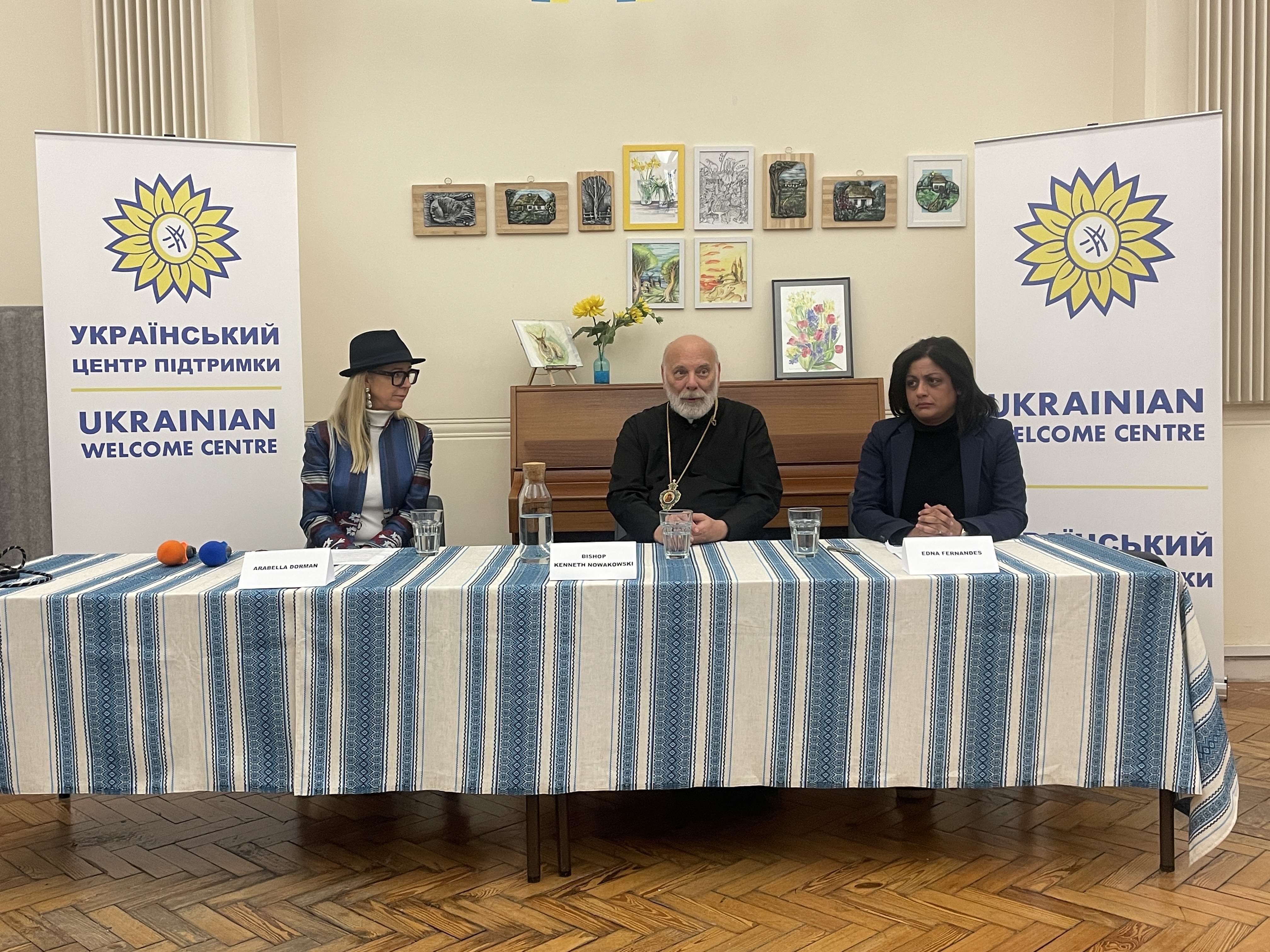
War artist Arabella Dorman called for more to be done to protect children caught up in war and conflict when she launched her exhibition ‘Child of War’ at the Ukrainian Catholic Cathedral in London this week.
Her powerful images, together with children’s paintings and the artefacts of war that make up the exhibition, present a grim picture of the suffering of children caught up in conflicts in Ukraine, Gaza, the Middle East and elsewhere: “In modern conflict children stand on the frontline … but it is not just about the trauma children suffer in war but also about the long term effects of that violence”, said Dorman.
“The suffering of children of children in war goes to the very heart of our humanity. It is time to heed that pain and act”.
She said the children’s paintings “offer a ray of hope”
“Children have this innate sense of dignity and strength … They dare to hope.”
The implications of the lasting impact on children were highlighted by Edna Fernandes, Co-founder of the charity Beyond Conflict, which is promoting the exhibition.
“Children can be condemned to repeat the cycle of horror they have experienced. This danger will reverberate through their lives and possibly be handed onto their own children.
“How can you rebuild peace if so many children are damaged in this way?”, she asked.
She called for tougher international action to safeguard children in war: “It almost seems that the targeting of children has become acceptable”.
Bishop Kenneth Nowakowski, the head of the Ukrainian Catholic Church in Great Britain, said being moved by the images of suffering is not enough: “It should not remain at the emotional stage but it should make us ask what else we in the UK can do to help these children.”
He said the UK had a proud record of welcoming people and highlighted the 220,000 plus visas issued under the Homes for Ukraine scheme: “This should be an example of best practice of how we can welcome strangers to the country.”
Dorman visited the area around Bucha, scene of some of the worst atrocities committed by the Russian forces during their initial assault on Kyiv in the spring of 2022, collecting stories from children which she has represented in many of her paintings. In addition, she brought back some of the lethal shards of shrapnel from a school in Hostomel, together with a collection of children’s shoes just abandoned in a classroom as the shells rained down and which now feature as part of the exhibition.

One of the most chilling paintings in the exhibition was inspired by a letter a nine year old girl, Galya, wrote to her mother who she had seen shot and killed in their car as they tried to escape the advancing Russians. Galya was hidden in the back of the car and was miraculously rescued by neighbours. This what she wrote:
“Dear Mama,
This is a present for you for the 8th March [International Women’s Day which was popularly celebrated as Mother’s Day in the Soviet Union].
If you think that you wasted your time bringing me up, then you are wrong.
Thank you for the best 9 years of my life.
Thank you very much for my childhood
You are the best Mama in the world. I shall never forget you. I wish you happiness in heaven! I wish you to go to paradise.
We shall meet in the paradise.
I shall try to behave well in order to get to the paradise.
I kiss you. Galya.”
Bishop Nowakowski recently returned from a visit to Ukraine and said he came back with a message for everyone in the UK: “When you go back tell people about us. Pray for us. And when we are no longer in the headlines do not forget us”.
• Child of War is on at the Ukrainian Catholic Cathedral, 21 Binney Street, London W1K 5BQ until 6 June. It is open from 10am to 5pm and is free of charge.
• Following its London debut, the exhibition will move to Berlin before returning to various locations in the UK.


About Arabella Dorman
Arabella Dorman is an award-winning, internationally renowned artist and one of Britain’s leading portrait painters. Dorman has painted members of the Royal family, senior military personnel and other high profile individuals.
As an officially accredited British war artist, Dorman has worked across the Middle-East since 2006. She has been embedded with the British Army in Iraq (2006) and Afghanistan (2009 – 2013). Her humanitarian work has taken her to Gaza, Palestine & Israel (2017) Lebanon, Syria (2018) and most recently, Ukraine (2023).

A few weeks ago I was privileged to be able to interview Alina Golubieva (pictured), who has spent the last four years establishing an insurance broking business in Kyiv. The interview was published in Insurance Post and they have been kind enough to allow me to publish it here so that more people can read it as it tells a powerful story of how resilience and hope are so much part of the Ukrainian DNA. The full interview can be downloaded at the bottom of this page.
It goes without saying that the war has hugely disrupted business in Ukraine, as Alina explained to me:
“We had a few clients in Kharkiv, we had clients in Kherson and in Mykolaiv, which wasn’t invaded, but still badly affected. And we had a lot of clients with employees in Mariupol as well. So basically, they relocated to either other parts, or we just saw the numbers there drop drastically.
“So, for example, one of our clients, they had about like 600 people in Kharkiv. Now it is only 50 people and 200 people are in other parts of Ukraine. Some of the people are relocated outside of Ukraine, but the war affected business immensely.
“There were layoffs. Some businesses couldn’t survive, because it affected them so much. And a lot of businesses now are moving their hubs outside of Ukraine, so they can support the business and support Ukrainians who want to relocate and still work for that company.”
You can read how this impacted her business and her predominantly female staff and how they have re-established a physical presence in Kyiv in a co-working office (see picture below). In a typical show of Ukrainian defiance the office complex is symbolically named Перемога (Peremoha) which means Victory in Ukrainian.


Much is being written and said about the potentially malign influence of artificial intelligence on elections, some of it very alarming. The main focus is on deepfakes – artificially generated pictures, audio and video – that are exactly what they say on the label: fakes and forgeries. Just how concerned should we be?
Some experts are keen to play down the threat, including Ciaran Martin, founding chief executive of the UK National Cyber Security Centre, part of GCHQ and is currently professor of practice in the management of public organisations at the Blavatnik School of Government, who I heard speak at a recent Association of European Journalists briefing.
He tried to be reassuring.
“A lot of this is not completely new. It is just that the technology has made it easier and it enables to spread faster … electoral interference in its current form has been going on for some time. It pre-dates AI by a hundred years.”
He cited the example of the notorious Zinoviev Letter which was published by the Daily Mail during the 1924 General Election campaign. It purported to show proof of connections between the Soviet Union and the British Communist Party and, by implication, the Labour government. It was later proved to be a forgery but its publication just four days before the election contributed to the Labour government’s substantial defeat.
He examined various recent examples from the UK, Europe and United States of attempts to interfere in elections, highlighting where several interventions, in his view, had failed.
The deepfake audio of the Mayor of London Sadiq Khan that was circulated around Remembrance Sunday last year was one example. This did not get much traction, argued Martin, primarily because his principal political opponents – The Conservative Party – and all responsible media outlets were not taken in by it and did not circulate it. That is true but perhaps a trifle naïve in assuming that significantly diminishes the risk of harm from deepfakes.
Given all political parties and their leading figures are vulnerable to this sort of attack there is a mutual interest in being very cautious about latching on to anything that looks or sounds suspect and exploiting it. The mainstream media is also learning quickly to greater care in verifying anything that does not come from an identifiable reputable source. That leaves plenty of scope for concern.
What about when social media is the dominant news outlet?
The growing proportion of people who rely on social media channels for their news is alarming. Several recent surveys have identified TikTok as the top source of news for Gen Z. In America it is increasingly popular as a news source for all generations, perhaps going some way to explaining the insanity of the US Presidential election race.
This brings us right back to the role of social media and the failure of all the major platforms to take responsibility for what is published on their platforms. They are publishers but have escaped nearly all the responsibilities that go with that role. It is fashionable to deride the “MSM” (mainstream media) but it is one of the key pillars of free, democratic societies. It is flawed. It is diverse. It does not always get things right or go about its role in ways that people find acceptable. But it is subject to the law and that law makes it ultimately responsible for what it publishes. Why are social media platforms not similarly regulated?
Recent moves such as the UK’s Online Safety Bill go some way but fall short of creating a mechanism powerful enough to stop the harm from deepfakes and other malicious online content, which goes far beyond the political sphere.
Of course, it would undermine their business model if they were treated as publishers as they would suddenly have to employ vast numbers of people to scrutinise and check content. Pre-publication verification would cripple them. That does not mean we should not be moving in that direction. Protecting society is far more important than protecting the business interests of the tech and social media giants.

Alongside that the MSM has to raise its game. Initiatives such as BBC Verify are a big step in the right direction. They bring to the fore what most media outlets have been doing for a very long time, helping reinforce the message that in this age of AI and social media you cannot always believe what you see and hear.The debate about the place of AI in society has only just started and we must not let its darker applications obscure the good it can do. Neither must we dismiss its potential to be used for nefarious purposes. Take away the outlets and you take away the incentives to use AI to cause harm and undermine our democratic processes.
• The images used in this article were generated using the AI tools in the Adobe Stock media library.

Two years since bombs and missiles started raining down on Ukraine and we are still waking up to reports of yet another bombardment of Ukrainian cities. People talk about the western democracies wearying as the war enters its third year. Think about how the people of Ukraine feel, both those still in their country – perhaps on the frontline – and those who have sought refuge elsewhere. They cannot afford the luxury of questioning the stubborn resistance to the Russian invasion: it is their country, their way of life, their culture that is a stake.
We have much at stake too. Democracy, freedom and the right of nations to determine their own future free from the threat of tyranny and repression. These are the values that are the foundations of western democracy. If we weary of standing by Ukraine and its people as it defends those values then we put our own way of life at risk, if not by way of brutal physical assault but through a degradation of everything good we stand for.
For some in our European family the threats are more physical and they know it. Look at the defensive lines the Baltic states are building along their borders if you want proof of the fear that stalks Europe as the spectre of Russian brutality casts its darkening shadow across our continent.
This is a European war and one that Europe may have to learn to fight alone, without the military might of the United States. Just when it is needed, America is becoming an unreliable ally, in danger of lurching back to the isolationism of the 1930s that Nazi Germany saw as a green light to invade its neighbours. Under a Trump presidency it could be even worse. He has already cast himself as Putin’s cheerleader. Far from being great again, America will be reviled by western democracies if it abandons them as Trump urges.
We are remembering Ukraine today because it is an anniversary but with the appalling conflict in Gaza hogging the headlines it has become easy to forget the suffering of the people of Ukraine. We must not let that happen.
• I was privileged to be part of a special Vespers for Ukraine at Brentwood Cathedral last night to pray for peace in Ukraine. It is a small contribution to supporting those, mainly mothers and children, displaced by the war and now part of our community, but one that is important nevertheless.
There were many Ukrainians in the congregation, some of whom read and said prayers in Ukrainian. We included several Ukrainian pieces of music in the service and the Ukrainians afterwards paid us the great compliment of saying we sounded like a true Ukrainian choir, mastering the sounds of their language and the deep feeling that the music embraces. I hope that gave them comfort in their fragmented lives far from home.

Photo: Graham Hillman
Slava Ukraini
This question has been gnawing away at me ever since the flurry of excitement across the London insurance market in the wake of Chancellor Jeremy Hunt’s promise to consult on the possibility of creating a special regulatory regime to attract captive insurance companies to London. I think we might be edging nearer getting an answer.
This week’s Labour charm offensive to the business community and financial services sector has offered a myriad of clues as to what their approach might be.
The promise by Labour’s shadow chancellor Rachel Reeves to “unashamedly champion” the financial services sector was rather overshadowed by the accompanying announcement that Labour would not reintroduce the cap on bankers’ bonuses. I am not sure what Labour thinks it has to gain by this. The ditching of the cap was one of the many controversial decisions made by the short-lived and disastrous Truss government. Reinstating it would be an obvious easy win for any party looking to place itself on the side of ordinary people battered by the endless waves of financial crises.
Championing the City of London and the key financial services sector makes more sense. Labour needs to keep capital and the business it generates in London if it is to deliver the financial stability lacking under the Tories in recent years and finance its commitment to restore public services.
This should mean that the captive insurance proposals developed by the London Market Group get a fair hearing if Labour forms the next government.
Where are the staff?
To deliver the huge benefits LMG and its supporters claim will take more than the creation of a more appropriate regulatory regime, however. That should be the easy part as there are plenty of models nearby. Luxembourg, Ireland and recently France have all shown how regulatory regimes for captive insurers can be accommodated within the rigorous European Union insurance regime. In the United States, Vermont has a thriving captive sector living alongside domestic insurers.
A key challenge so far little remarked upon will be staffing.
The London insurance market already describes itself as being in the midst of an escalating war for talent. The arrival of captive insurers will exacerbate the already alarming skill shortages across the market. It will also push up wages, blunting some of the appeal of London as a new captive domicile.

Of course, one solution that could ease that would be to restore the free movement of people across the EU. This would probably have to be part of setting the UK on a trajectory to rejoin the Single Market which would never be acceptable to a Tory Party still blighted by deep splits over Europe but could find more favour with an incoming Labour government. This would not be undoing Brexit as the extremist anti-EU elements inside and outside the Tory Party claim. The Single Market was not on the Brexit referendum ballot paper and leaving it should never have been part of the Brexit settlement.
To make the captive insurance market plan work is going to require an engagement with bigger issues than tweaks to the City’s regulatory regime.


 David Worsfold