

Reform UK’s sustained rise in the opinion polls and local elections can no longer be ignored by those who hope that Farage and co never get the opportunity to put their distorted, divisive, ignorant policies into action by playing a part in the government of this country.
As the drip, drip of detail seeps out from what passes for policy making machinery in Reform, we can see its agenda is being shaped by the MAGA (Make America Great Again) agenda being relentlessly pursued by President Trump. It is surprising just how little detailed scrutiny this is being subject too.
This seems especially true of financial services. Last month at Reform’s conference we heard the start of Nigel Farage’s assault on the current regulatory regime for financial services. This featured a pledge to scrap much of what was put in place after the global financial crisis. It included a strong commitment to what Reform is labelling as “self-regulation”, perhaps involving the complete abolition of the Financial Conduct Authority.
This was followed up by a more specific pledge to abolish the FCA from Aaron Banks, founder of the Leave.EU campaign and a former insurance broker close to Farage. In an interview with the business publication Insurance Age, he said the FCA and the Solicitors Regulation Authority should both be abolished. He said nothing about how the self-regulation would replace them would work.
Last week, Farage unveiled another facet of his policy for the financial services: greater political control over the Bank of England, another policy straight out of the MAGA playbook. Does he have an original thought?
Fascination with crypto
A few days later he made an appearance at the Zebu Live conference in London, best described as a gathering of crypto zealots. Again, he was mimicking his hero Trump, who has embraced the world of digital assets and crypto, making sure he and his family profit handsomely from it, not least by lessening the regulatory oversight of the sector.
Farage gave a lot away at the Zebu event, lauding the lack of transparency and accountability of crypto assets: “Being in control of your own money, making your own decisions, free from authoritarian government. Crypto is the ultimate freedom of the 21st century and debanking taught me that for life”, a reference to his own dispute with Coutts in 2023.
Do we really want a parallel financial world where the already rich, and often disreputable, can make themselves richer with no accountability?
I continue to shudder at the way the super-rich never stop at seizing any opportunity to make themselves richer, while many, like Farage, build a narrative to appeal to those who feel society has left them behind, by demonising and dehumanising people who often have even less themselves or are even more vulnerable.
This obsession with deregulation makes me fear for the wider good of society. Let’s be clear, the sort of self-regulation Reform envisages would be a charter for spivs, charlatans and crooks. We have tight regulation in financial services because there have been too many examples of the unscrupulous using lax regulation to exploit people.
Scandal is never far away
I have reported too many major financial scandals to know that light touch regulation is always a failure. Payment protection insurance, endowment insurance and personal pensions mis-selling and the most recent, the £11bn car finance scandal, are just a glimpse of the scandals that explain why we have tight, compulsory regulation. Lessening that is very hard to justify if you believe people need protecting from those who would take advantage of them.
Is the current statutory regime occasionally over-prescriptive? Probably. But rarely does a year go by without some necessary intervention by a regulator to protect customers show why an empowered, independent regulator is essential. It creates a level playing field which protects the majority of ethical, honest businesses, as well as consumers.
What Reform wants to do will open up our financial services sector to crooks and charlatans who will exploit people and businesses. They have nothing to offer the City, the financial services sector or the country.

The enthusiasm sweeping the City of London and the wider financial services sector following the Chancellor of the Exchequer’s Mansion House speech on Tuesday evening, which came hard on the heels of that morning’s announcements at an event in Leeds of a wide ranging package of changes to financial services regulation, is palpable.
It makes me nervous. Why?
Quite simply, because I have been writing about financial services for long enough to have seen too many deregulatory initiatives end in tears.
There are many positive features among the proposals that have flooded out of the Treasury this week: simplification of listing rules to encourage IPOs, the creation of a captive insurance regime in London and the promise to regulate ESG (Environment, Social and Governance) ratings providers, although the latter is diluted by the dropping of the plans for a UK green taxonomy.
The two areas that make me nervous are the relaxation of some of the regulations put in place after the 2008 financial crisis, especially the clear separation of banks’ wholesale and retail operations and the instance that those in charge of financial institutions demonstrate their competence and probity through the Senior Managers Certification (SMCR) scheme.
‘Tell Sid’ to ‘Break the Chains’
It is the push to persuade retail investors to take more risks with their money by committing their savings to stocks and shares that really starts ringing alarm bells with me.

There are very good reasons why savers should keep a decent proportion of their money in investments that cannot lose their value, such as Cash ISAs or Premium Bonds: it will be there when they need it. The threat that the government should back a promotional campaign to encourage people to put savings – should they have any – into riskier share-based investments should be quashed. It never ends well. We had this nonsense in the 1980s and early 1990s with campaigns to encourage people to buy into privatisations – ‘Tell Sid’ – and then the push to persuade people to leave perfectly good occupational pension schemes and invest in a new breed of private pensions instead – ‘Break the Chains’.
The latter ended in disaster as it unleashed a wave of mis-selling that cost the sector over £12bn to correct. The reputational risks for Rachel Reeves, the government and the sector are enormous.
Unfortunately, the temptation to mis-sell risky investments will be irresistible to some advisers. I have already seen comments claiming that revising the current definition of Consumer Duty to allow a presumption in favour of stock market investments will allow advisers to persuade customers to move money out of interest-bearing accounts. Worrying.
Rachel Reeves needs to stop vacillating over the future of cash ISAs as this breed of less scrupulous adviser is already circling in the hope that the cap will be reduced. Cash ISAs are a perfectly decent, well-advised investment for people who need confidence that their savings will be intact just when they need them.
Stock markets go down – far and fast
Perhaps an advertising campaign should start with reminders of the catastrophic stock market crashes in 1987, 2000 and 2008, as well as the volatility in the wake of Trump’s unpredictable economic policy pronouncements. Yes, markets recover but some people will not be in a position to wait for them to return their money.
The Chancellor’s frantic search for growth must not put people’s savings at risk, nor must it turn a blind eye to the lessons that were learned in the wake the 2008 global financial crisis.

Over the last few weeks it has been a great privilege, and a time-consuming challenge, to review hundreds of entries for the Women in Insurance Awards. The stories are frequently inspiring, often deeply moving and a reminder that in every walk of life women face many barriers to achieving their full potential.
Now in their seventh year, the Women in Insurance Awards are firmly established as the biggest celebration of the achievements of women in the insurance industry. This year they also feel like a bulwark against the growing assault on diversity and inclusion from the ignorant, prejudiced forces of darkness on the far right.
Led by Donald Trump, their determination to destroy the hard-won progress of decades has cowed businesses into retreating from lofty promises to embrace Diversity, Equity and Inclusion (DEI) and deliver lasting change. This corporate cowardice comes as no surprise, as it follows hard on the abandonment by most of the world’s largest financial institutions of commitments to tackle climate change. This started with spurious claims from Republican states that co-ordinated action through initiatives such as the Net Zero Insurance Alliance breached competition law. This was a smoke-screen for climate-change denial, now given further credibility by Trump. No fight, no backbone, just meek submission was the depressing response of most business previously quick to align themselves with the net zero initiatives launched by Mark Carney at COP26,.
Now that contagion of cowardice is infecting corporate responses to the far right’s attacks on DEI. So far, the rush for the exit door does not seem as panicky as it has been over climate change but it is still happening. Bold statements about DEI policies are being watered down or disappearing from company websites. Collectively, executives are taking a lower profiles, although there are many exceptions. In the public sector in the UK, local councils that fell into the grubby hands of Reform in May are purging DEI policies.
In this context, the huge support for the Women in Insurance Awards seems like an act of defiance: a determination to say 1000s in the market believe in diversity and inclusion and understand the great value it delivers.
It is not the only sign that many are drawing a clear line in the sand. Insurance Post’s relaunch of its Diversity and Inclusion in Insurance Awards will seek out those committed to the wider DEI agenda, We will watch carefully those business that support the awards, as well as those conspicuous by their absence. There is a growing list of organisations and networks in the UK insurance market committed to promoting DEI: they deserve support as this is a cause we cannot abandon.
When the winners of the Women in Insurance Awards are revealed at Grosvenor House on 23 October it will a great celebration: it will also be an expression of solidarity in these darker times.
If you doubt the darkness of the clouds that are depending all around us, just pause to reflect on the conversations the insurance and financial services sector was having just two years ago about climate change, ESG (Environment, Social and Governance) and DEI. Would you have imagined where we are today?

Many of us have supported the development of ethical investment strategies since the concept first became mainstream in the 1980s when firms such as Friends Provident promoted a new generation of ethical investment funds. Since then the concept has had various iterations and is now embedded in the Environment, Social and Governance (ESG) strategies of many major financial institutions.
Once, it was almost automatically assumed that spending on weapons had no place in an ethical or ESG investment strategy. Now, we must question that.
A group of Labour MPs have posed this question to our financial institutions in an open letter published in the Financial Times (below for those unable to access the FT’s content).
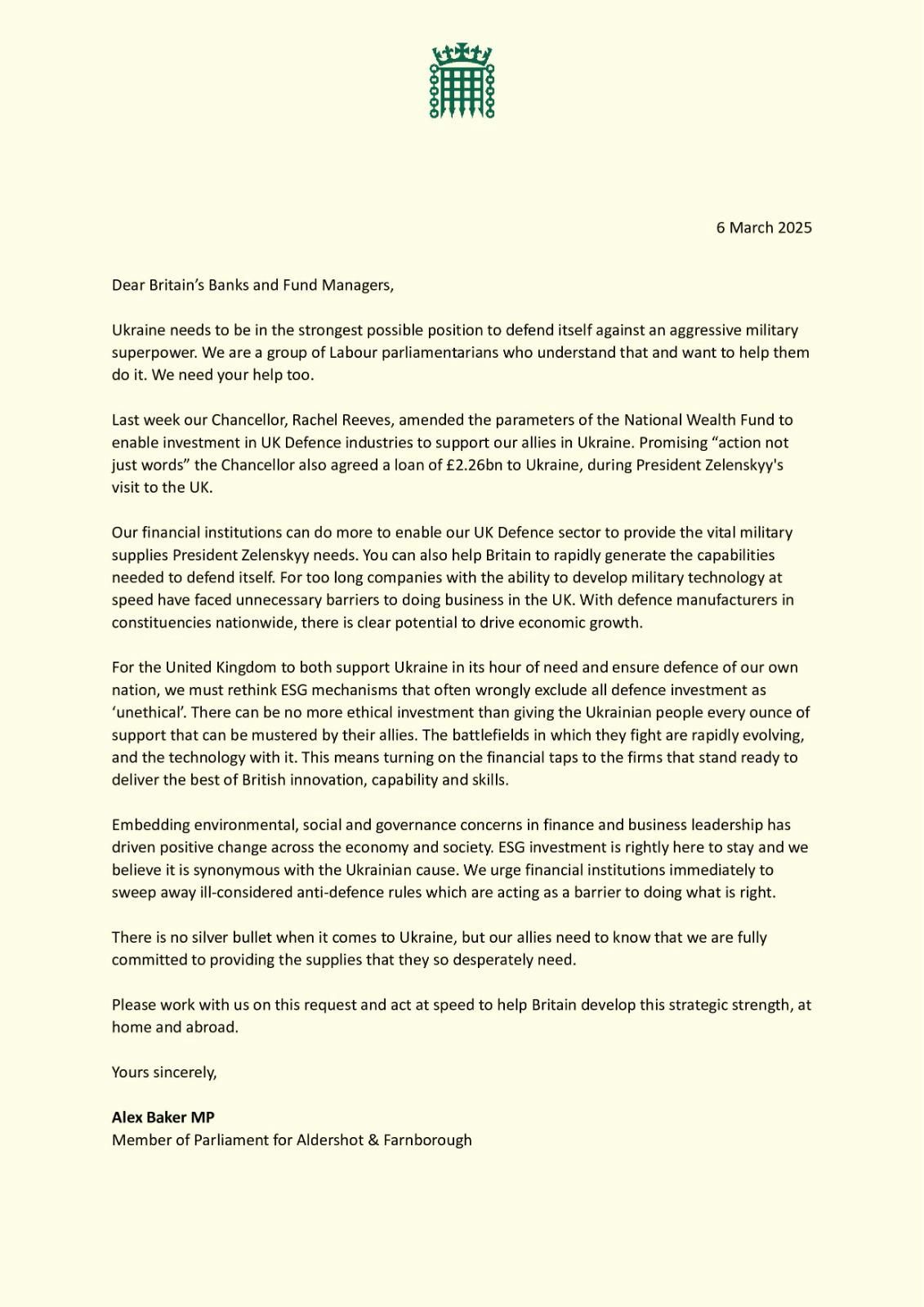
Their arguments are compelling, even though they make uncomfortable reading for those of us who hoped – and campaigned – for a more peaceful and safer world. Those hopes have been dashed. We now live in a more dangerous world, one where the threats to freedom, democracy, tolerance, prosperity and the rules-based international order are more acute than any time since the Second World War. Those threats are not theoretical or intellectual, they are violent, brutal and existential.
Sadly, force is going to have to be met with force if the values we so passionately hold are to be protected. No-one should take any pleasure in having to argue this.
What role for our nuclear weapons …?
Of course, this a complex issue. It will be about how we re-arm and where we find the money form. It also brings into the mix our nuclear weapons and the future of NATO.
Again, I find myself in a dilemma, at least on the question of nuclear weapons as I have long campaigned for their abolition. I find myself breathing a sigh of relief that ourselves and France still have a nuclear deterrent, although only France’s can be described as independent as the mistakes of the Thatcher government when replacing Polaris have made us too dependent on America.
One aspect I do find encouraging is the determination of Europe to take greater responsibility for its own security.
… and what role for NATO?
I have never been an enthusiastic Atlanticist. I thought back in the 1970s that a combined European Defence Force should be a key part of an expanding European Union to give Europe a chance of controlling its own destiny, liberated from dependence on the Americans. Then, through NATO, we were part of a world polarised between the West and the Soviet Union, the Russian Empire of its day. A third force (China wasn’t in the picture then) seemed to me to offer a better prospect of avoiding the tensions between the two great power blocks escalating into anything more serious.
Such was my dislike of NATO and distrust of the Americans that when the Liberal Party and the Social Democratic Party merged to create the Liberal Democrats in the late 1980s, I was one of a group of Liberals who opposed including mention of NATO in the preamble to the new party’s constitution, an argument we thankfully won. Europe now has to seize the chance to shape its own destiny, founded on the values previous generations fought for and sacrificed so much to defend. NATO has to become a partnership of two equals if it is to have any relevance in the future. We have to to ready to accept that the current US government may not be prepared to commit to that, reinforcing the need for Europe to move quickly and decisively, embracing UK Prime Minister Kier Starmer’s appeal to a”coalition of the willing”.
That will need huge financial resources which is why we must look to financial institutions to play their part by investing in those companies that are now needed to help re-arm us. If they do not, then what values embedded in the ‘Social’ part of ESG will be left?
As the dark clouds of bigotry and ignorance emanating from the White House cast their lengthening shadows across the corporate world, we all have a duty to support those trying to hold the line and preserve Diversity, Equality and Inclusion (DEI) initiatives.
The last few weeks have seen major businesses retreat from previously proudly proclaimed DEI policies, clearly following the lead from President Trump and his emboldened “anti-woke” stormtroopers. The sackings of top black and female military commanders can surely leave no-one in any doubt about the true motivations for these savage actions.
To see some of the world’s largest and most powerful businesses fall in behind this is shocking but not surprising.
The collapse of the many initiatives around the COP 26-inspired Glasgow Financial Alliance for Net Zero (GFANZ) showed how easily intimidated major firms are when political sabres are rattled in their direction. The rapid withdrawal of insurers, banks and asset managers from GFANZ’s initiatives showed a shocking degree of corporate cowardice. They meekly caved in in the face the threats of legal action over competition law. These were crudely contrived and entirely specious. We all know the real motivation of the Republican attorneys-general was climate change denial.
Some of the same suspects – Goldman Sachs, Blackrock, Wells Fargo, Citibank and Morgan Stanley among others – have been quick to abandon or water-down their DEI policies at Trump’s behest. They have been joined by two of the big four global consultancies – Deloitte and KPMG. Other financial, consulting, service and manufacturing giants will no doubt follow.
But there is hope.
Deloitte UK has distanced itself from this spineless retreat, as has McDonald’s UK operation. Others are hopefully quietly doing the same. I do not doubt the huge challenges the UK and European executives of these global businesses face in trying to hold the line against what must be uncomfortable pressure from their US counterparts and bosses.
That is why we must do everything we can to support them and help them hold the line on DEI. Some may say why? There are many answers to that question: fairness and justice leap out. But businesses benefit from having a more diverse, representative workforce. Supporting DEI is a win-win for everybody.
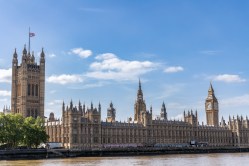
More members of the House of Lords – 38 more to be precise – were named by Prime Minister Kier Starmer just before Christmas. British politics takes this enormous patronage in its stride, but it shouldn’t.
The House of Lords is an affront to democracy. It has no place in any democratic institution as we move into the second quarter of the 21st century. Adding to its 800 plus unelected members has little justification beyond short-term political expediency. Labour’s pleas – 30 of the new peers are Labour – that it needs to balance the years of the Conservatives stuffing the House of Lords with their supporters is a very weak argument, especially when it is not accompanied by a plan for meaningful reform.
Labour will point to its commitment to bring to an end to most outrageous anachronism by expelling the remaining 92 hereditary peers sometime next year, but that barely touches to problem of the huge democratic deficit of having an unelected second chamber.
There is talk of bringing in a compulsory retirement age of 80 but that would remove no more than another 15-20 members, still leaving it with over 730 active peers.
We need to go further, faster.
Clearly, in the long term a complex modern democracy needs a elected second chamber, although whether one is required at all should be the starting point for any debate. There are many views on how reform might be achieved and there should be a thorough, deliberative and inclusive process so that we emerge with a solution that will enhance our democratic processes and constitution – perhaps it might even act as a catalyst for putting our constitution in writing.
In the meantime, we need to find a way of cutting the House of Lords down to size, especially now it doesn’t have the burden of scrutinising European legislation since we left the European Union. Removing the 25 Lords Spiritual – representative of only one denomination of one religion – would be another step in the right direction but would still leave it with over 700 members, larger than the democratically elected House of Commons.
My solution to cut it down to size sooner would be to impose a limit on how long people can serve.
We should aim for a maximum ten year term for all peers. This could be introduced gradually, perhaps starting with all those who have already served, say, 15 years and reducing that year-by-year until reaching a maximum term of ten years. By the time we have reached that – which would be just after the end of this Parliament if it goes its full term – we might have elected a government with a mandate to complete the job with a plan for a new, democratically elected second chamber. We can only hope.
Change its name now
One reform that should be immediate is a change of name. How have we got this far into the 21st century with a gender-specific name for one of our main Parliamentary institutions? It should be changed to the House of Peers immediately. No feeble excuses about tradition, history, the need to change a few signs acceptable. Get on with it.

The sound, fury and partisan debate over the UK budget, American elections, Ukraine and the Middle East – just for starters – has drowned out some important comments about media freedom, journalism and artificial intelligence from the UK Prime Minister Kier Starmer.
Writing in The Guardian at the end of October, he managed to convey the right sentiments without actually making any firm commitments, a hallmark of his political style. Some of his comments seem to jar against what his government is doing – or not doing in some cases.

His comments on SLAPPs – Strategic Lawsuits Against Public Participation – epitomise this problem.
In his article, Starmer condemned the use of this legal strategy to “intimidate journalists away from their pursuit of the public interest”, adding that “Such behaviour is intolerable and we will tackle the use of SLAPPs to protect investigative journalism, alongside access to justice”.
Sounds all very fine until you put those remarks against those of his government’s justice minister in the House of Lords, Lord Ponsonby. He recently said the government could not commit to bringing standalone legislation on SLAPPs. Instead he promised a review.
You have to ask: why is a review necessary?
In the last Parliament the Labour MP for Caerphilly, Wayne David, put forward a Private Members Bill to deal with the outstanding issues surrounding SLAPPs. His bill was supported by the front benches of all parties but failed to make progress because of the unexpectedly early General Election. Mr David stood down at the election and no-one has picked up his well-crafted Bill.
There is no need for a review when there is already a Bill that Labour supported in opposition. It would extend the limited action against SLAPPs already contained in the Economic Crime and Corporate Transparency Act last year which only covered economic crime and was passed a year ago. It created a robust legal framework for removing this tactic from the arsenal of the rich, powerful and corrupt. Its scope just needs to be extended.
The pieces are already in place. In just needs the political will to pick them up and fashion them into legislative action.
No clarity on AI
There is a similar problem with the Prime Minister’s comments on artificial intelligence, especially the way big tech is stealing copyright material to train its AI platforms. In his desperation to make the UK welcoming to big tech, he has suggested that the owners of copyright material should have to opt out of allowing their content to be used, rather than retain full control over their work, putting them in a position to deal with big tech on a more equal footing and ensure fair payment for the use of original material.
This is one of many aspects of AI that will have a profound impact on how people source and access news. The established media has much to offer the AI world and many opportunities to use it positively but not if they are denied revenue that should be legitimately theirs.
Those of us in the media in the UK can take comfort from Prime Minister’s strong statements in favour of press freedom and the acknowledgment of the crucial role of independent journalism as one of the cornerstones of democratic society. That is worth having in a world where so many governments are turning against the media, seeking to supress and control it, often violently.

As the world holds it breath with the US Presidential election heading for its climax in a little over a week’s time, dark clouds are gathering over the once prized values of media freedom.
Just a week after Patrick Soon-Shiong, the billionaire owner of the Los Angeles Times, instructed the paper’s editorial board not to make an endorsement for president, Amazon founder Jeff Bezos, who owns the Washington Post, similarly stopped that paper offering an endorsement of any candidate. It is assumed that both papers would have endorsed the Democrat nominee Kamala Harris.
This unprecedented interference in editorial freedom has provoked a fierce backlash among journalists in the United States.
Mariel Garza, the editorials editor of the Los Angeles Times, resigned, making it very clear why she was taking a stand: “I am resigning because I want to make it clear that I am not okay with us being silent. In dangerous times, honest people need to stand up. This is how I’m standing up”, she told the Columbia Journalism Review.
Marty Baron, the former executive editor of the Washington Post, condemned that paper’s decision as “cowardice, with democracy as its casualty”.
He pointed the finger at the Republican candidate Donald Trump, saying that he will “see this as an invitation to further intimidate the owner” of the Washington Post. “Disturbing spinelessness at an institution famed for courage”, Baron added. Ironically, that statement was issued on X (formerly Twitter), now owned by another billionaire, Elon Musk, who has been busy spending millions of dollars buying votes for Trump.
Trump has long been an enemy of a free press, repeatedly labelling anything that is critical of him as “fake news” and throwing out baseless accusations about left-wing conspiracies against him.
He has frequently threatened to strip broadcast licences from the three biggest US television networks – ABC, CBS and NBC – in retribution for being fact-checked during the campaign and for news coverage that Trump claims is unfair.
“For the past decade, Donald Trump has been running a campaign against the media straight out of the playbook that authoritarians have used around the world, which is to threaten retaliation against news organizations if they don’t provide him with favourable enough coverage,” says Ian Bassin, an attorney and founder of the not-for-profit advocacy group Protect Democracy. “We are seeing now the seeds of that campaign bearing fruit.”
Trump has made it very clear during the campaign that, if elected, those who have opposed him will pay a heavy price. Bezos, Soon-Shiong (who owns a vast medical products business that needs government licences) and Musk have much to lose if they antagonise a vengeful Trump. But that is not how democracy works. That is not how a free press works.
The proud claim to be “The Land of the Free” is starting to look threadbare as its great press institutions are silenced. It will be left in tatters if Trump is elected.

The role that social media has played in promoting the far-right violence of the last week is now firmly in the spotlight. The number one culprit is X with its owner, Elon Musk, now adding his hate-filled bigotry to an already volatile mix.
I have not been convinced for some time that X adds much, if any, value to those seeking constructive engagement or wanting to promote good news about themselves, their business or their interests. Since Elon Musk took over Twitter and rebranded it, the quality and engagement on the platform has declined drastically. It has been clear that many of the organisations and people we once believed we could engage with through the platform have either left or stopped using it.
A year ago, I was already in despair at how Musk was wrecking a once vibrant, engaging platform – X marks the spot where Musk buried Twitter.
Having put considerable effort into my own and other organisations’ presence on the platform I have been reluctant to acknowledge the full extent of its decline. However, the last few months, and particularly the events of the last week, have now convinced me that the time has come to leave the platform.
During the General Election campaign it was swamped with lies, distortions and outright bigotry in the name of Reform. Much of that is what now gives cover to the violence of their far-right allies. It is straight out of the playbook that Trump uses in the US. His rhetoric and lies about the last Presidential election emboldened groups such as the Proud Boys to launch their assault on Capitol Hill. The same is now happening here and X is at the heart of it.
Musk himself has voiced the view that this is the start of civil war in our country, another narrative gathering force in the US. It will only get worse as the US elections approach and probably fuel further assaults on our institutions in the UK. It is no coincidence that the police have been as much a focus of the violence as immigrants and Muslims: they are seen as representing the state. There are too many uncomfortable parallels with the rise of the Nazis in Germany in the late 1920s and 1930s.
So, it is not merely that X no longer offers any value. It is being used to destabilise society and our institutions. I believe to remain on it is reputationally damaging to any decent individual or organisation.
It is time to go.
• For one last time, I will put a link to this post on X before deleting the account later today.
Don’t say it too loudly – at least in Liberal Democrat circles – but we might all be breathing a sigh of relief at the vagaries and distortions of our first-past-the-post electoral system come 5 July. Decades of campaigning for a switch to proportional representation have come to nothing. That failure might save us from seeing dozens of far-right Reform MPs elected.
It is ironic that those of us who believe we need a fairer electoral system are faced with the prospect of watching Reform claw its way up the opinion polls, possibly even overtaking the Tories to claim a marginal second place, and yet come out of the election with a handful of MPs at best. Just for once, it could be that the Liberal Democrats, aided by a ruthless strategy of targeting their best prospects, benefit from the distortions of the first past the post system.
With ten days to go plenty could happen, especially as we are in unchartered territory with the rise of Reform. We have seen dramatic collapses in the Tory vote in opinion polls in the run-up to General Elections before but on polling day many Tories find they cannot let go of mother’s apron strings. When the real votes are counted the collapse is rarely as bad as forecast. They may do well enough to fend off the threat of Reform overtaking them.
Whatever happens, we will be looking at the starkest proof yet that the first-past-the-post system is not fit for purpose. It simply doesn’t cope with an increasingly fragmented multi-party system.
The rise of Reform should not be an excuse for those of us who believe in a fairer electoral to diminish our commitment to see one put in place. We need to separate the two issues, although that is not easy right now.
A nightmare scenario
The nightmare for many of us will be if Nigel Farage gets elected with three or four others from his far right fan club and has a platform to constantly bleat about being the “real” leader of the opposition, regardless of how many more MPs the Tories, Liberal Democrats or SNP have.
The polls in Clacton apparently show that Labour is second to Reform. We certainly need other left of centre voters – Liberal Democrats and Greens – to swing behind Labour and hope that reasonable centrist Tories, who are almost politically homeless at the moment, realise they have to hold their noses and vote Labour to stop Farage.
This need for a broad progressive and centrist alliance to stop the rise of the far right has dawned on the French almost too late. When the dust settles on our General Election – and the French election – we are going to have to take stock of what has gone so wrong that millions of people are being seduced by the siren voices of evil.
We need a powerful narrative to combat this. Right now it is hard to see where it might come from.


