

This will be the Brexit election. Labour may try to ignore the issue – judging by Jeremy Corbyn’s initial reaction – and shift the focus to the NHS, austerity and living standards but they will remain minor issues. It will be about Brexit. The fate of parties and individual MPs will hang on how they play this divisive, toxic issue.
Tories
The Tory manifesto will commit them to a hard, uncompromising Brexit. This will suit those MPs in favour of leaving the European Union but it will be a tough campaign for those who backed Remain and who might be feeling the hot breath of the Lib Dem passion for Europe on their necks.
The two big prizes to be gained for backing Brexit will be winning back votes lost to UKIP in the last two elections and potentially gaining large numbers of anti-EU Labour voters, although I can’t see that actually delivering many Labour seats into Tory hands.
The Tory strategy, especially regarding the Lib Dems, is likely to remain fairly fluid until after the local elections in the first week of May. Any hint of a major Lib Dem revival will see them commit significant resources to the constituencies deemed to be most under threat with blunt accusations about ignoring the will of the people. If that doesn’t happen then they will likely extend their targeting of vulnerable Labour seats.
Labour
The only thing that could have been worse for Labour would have been if Theresa May had waited until the boundary review was completed. By undoing the gerrymandering of the Blair government this threatens to wipe out dozens of Labour seats. New boundaries or old, Labour is in complete disarray: all over the place on Brexit, crippled by infighting and with an organisation that is incapable of managing the office tea round let alone a General Election.
All the signs are that Corbyn will stubbornly stick to his anti-austerity agenda. This may be very worthy but surely he hasn’t the ability to drag the campaign away from its Brexit core? If there is a little caution in answering that question it is because of the way he triumphed against the odds twice in Labour leadership elections.
It is still hard to see Labour doing anything other than losing 20 to 30 seats, mainly to the Tories who will work hard to attract anti-EU Labour voters.
Liberal Democrats

Farron: big test for inexperienced leader
The strong anti-Brexit stance of Tim Farron has already brought the Lib Dems electoral success in Richmond Park and is likely to do so in other former Lib Dem seats. They should regain several of the seats they lost in the 2015 meltdown, especially where they can exploit strong pro-EU sympathies against an equivocating or Brexit supporting Tory MP. The hopes of many in the party of emerging with 50 to 60 seats seem wildly optimistic at this stage: half that number would represent a major success.
The election has probably come too soon for their over-stretched organisation to exploit Labour’s potential vulnerability in some urban seats over its hesitant response to Brexit.
The biggest unknown is how the relatively inexperienced Farron will perform and whether he can impose himself on the campaign from a very weak position.
UKIP
Virtually leaderless and with its main paymaster having gone off in a huff this election could mark the end of UKIP as an even vaguely credible political force. They will find their vote relentlessly squeezed by the Tories and even with Labour performing poorly it is very hard to see any prospect of the once much trumpeted UKIP threat in Labour heartlands amounting to anything.
SNP
The SNP will remain the dominant force in Scotland, the only question being just how dominant? The strong pro-EU majority in Scotland won’t be easily attracted to the Tories and Labour hasn’t done anything to win back its once loyal voters. The Lib Dems could take back a couple of seats with their anti-Brexit, pro-Union message but we can be certain of a strong SNP presence at Westminster for several more years.
There will be twists and turns, the odd rogue opinion polls and possibly some shockwaves from the French presidential elections but as the starting gun is fired on a seven week campaign the smart money has to be on May being re-elected with an increased – but not overwhelming – majority and a renewed mandate for a hard Brexit.
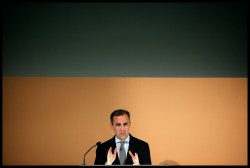
The letter from the governor of the Bank of England, Mark Carney, to UK financial institutions telling them to prepare contingency plans for a hard Brexit with no trade deal, equivalence or passporting for financial services is a clever public relations manuoeuvre.
Some of the headlines it has attracted might leave readers with the impression that many financial institutions are in a state of denial over the likely outcome of the Brexit negotiations, naively clinging to hopes of a deal that doesn’t disrupt the cross-border trading and client relationships. In my experience of talking to a lot of senior folk in a wide range of City firms this is far from the truth. From last summer they have been drawing up plans for a hard Brexit with few deals that preserve the status quo with Europe.
What they have struggled with is making these plans public.
 As the sand starts to fall fast on the Article 50 negotiations they need to make decisions, not least on how to maintain crucial access to European markets. In particular, they need to finalise decisions on where to domicile their European business. This is where they find themselves in a difficult position.
Firms know these decisions have to be made in the next few months if the regulatory hurdles are to be negotiated, premises found and equipped and staff recruited in time for the end of the Article 50 process in March 2019. However, going public on these decisions represents a huge vote of no confidence in the ability of the UK government to come out with a softer Brexit deal that keeps access to European markets for financial services on the same footing as present. This doesn’t wash with the Brexit ministers who don’t want to hear what they consider to be defeatist talk.
Tensions in City firms
We have seen tensions surface at firms when people have gone public prematurely on their plans, such is the nervousness about alienating government ministers – JLT backtracks on Brexit contingency plan statements. Carney’s letter is a smokescreen to allow them to break cover and push on with their hard Brexit plans.
It follows hard on the heels of Lloyd’s of London announcing its decision to set up a new office in Brussels. This has given the green light to the rest of the insurance industry to move ahead with their plans.
Negotiations have started badly
If there were people in the City who really believed the UK government could exit the EU and maintain almost uninterrupted access to European markets within the frantic Article 50 timetable, that mistaken confidence has been vigorously shaken by the opening phases. Theresa May’s notorious inflexibility has seen her government already outmanoeuvred on free movement of people and Gibraltar, not to mention the Scottish independence referendum.
Financial institutions know they must take control of their own destinies because they are not safe in the government’s hands. Carney has given them the green light to do just that.

I was asked to participate in a careers fair at my old school recently and knowing that one of the most frequently asked questions of those of us representing the media would be how to go about getting work placements I thought I would see what advice was around to help students.
There is some excellent advice on CVs, covering letters, building-up portfolios and interviews but very little on what sort of questions a prospective journalist should ask. In my experience few things kill the prospects of someone getting a placement than not having any questions, so I put together some advice for the students which I thought I would share more widely.
•••••••••••••••••••••••••••••••••••••
Applying for Journalism Work Experience
When you apply for a placement or internship you will be asked plenty of questions about why you want to work in journalism or the media. Always research the title or programme you are applying to by looking at its website (and the website of its parent company). If it has a print edition try to get hold of a recent copy (not always possible with specialist publications).
Look at some of the recent major stories it has covered and expect to be asked about them or similar stories and what the angle might be for their readers.
When you are asked why you want to be a journalist remember that journalism is as much about finding information as it is about writing so display an inquiring mind, a willingness to talk to people and a desire to communicate.
You may be asked about current media-related controversies such as the Leveson Report and state-regulation, fake news or celebrity privacy as a way of testing how deep your interest in journalism and the media goes. You don’t need detailed, erudite responses but be prepared to demonstrate an interest in the industry you want to work in.
There is plenty of advice available online about what to expect in terms of the sort of questions you might be asked. Journalism.co.uk is a very good source.
Ask questions
One area where people applying for placements frequently fall down is in not having any questions of their own. No-one is going to employ someone as a journalist who doesn’t ask a few questions.
Here are ten suggestions to get you started.
- Will I get a chance to write something that could be published?
You should aim to come away from a work placement with something tangible you can show from your time there. Obviously, it would have to be good enough but you should be given the opportunity.
- Who are your readers/users/viewers and what are their information needs?
Who you write or broadcast for is every bit as important as what you write about. You should do some basic research on this before any interview so you might frame it by saying “I know your readers are marine engineers/people in Woodford but how do you identify what stories they are interested in?
- Where else do your readers get their news and information from?
A good follow-up to this would be to ask about their main competitors and how they differentiate themselves from them.
- How has your publication/website/media station changed in recent years with the huge shifts in digital consumption?
Every media organisation is being challenged by the digital revolution. It has disrupted media consumption and the revenue models. It has meant a shift from print to digital but if you are talking to a print publication never assume that print is going to die: by all means ask their view but don’t make it look as if you have assumed they have no future!
- What influence does social media have in your market/area?
Or you could ask which social media platforms are the most important to them and how they use them.
- Will I get the opportunity to attend events?
Depending on the nature of the publication there might be a variety of events, such as conferences, shows, launches or awards nights. Ask if you will be able to go to anything, especially where you might be able to meet readers.
- Is there anything you would like me to work on in advance?
Suggestions could include getting familiar with the publication’s style, researching some story ideas, finding a fresh angle on a long-running story or just familiarising yourself with the news about the subject, industry, location, topics etc the publication covers.
- Will I have a mentor?
For a short, two-week placement this might be a luxury but you should ask about opportunities to speak to people at different stages of their careers, especially those only a few years into it as they should have plenty of relevant advice.
- What should I wear?
Dress codes are very flexible nowadays but they still exist and you need to make sure you fit in. If you don’t get any information about this err on the side of being smart to start with.
- Will I get paid or get travelling expenses?
This often causes embarrassment later on if everyone isn’t clear at the start. Company policies differ greatly on this and often the person deciding whether to offer you a placement will have no say over the policy so it won’t be an opportunity to bargain.
Pitch some ideas when you finish
At the end of a successful placement you should explore whether there are any opportunities for you to keep working with them.
This is might take the form of writing for them as a freelance – for which you should expect to get paid. However, you will have to make this happen by pitching some well-thought through ideas to them.
Or, you could ask about a longer placement during the holidays. If it has gone well they might view taking you on during the holidays as an easier option than finding someone new.
Download a pdf of this advice placement-advice
There is also an excellent article by Lucy Sherriff in Huffington Post about how to make the most of a placement.

As the clock ticks relentlessly towards the day when the UK government finally presses the button on Article 50 to initiate formal talks about about how the UK might leave the European Union, there seems to be less consensus and more confusion about that process than ever.
In the midst of this confusion we have lawyers trying to put Article 50 in a straitjacket. This will not do anyone any favours.
The case being drawn up in Ireland may seem admirable in its intentions but it could so easily backfire. Those who want to keep open the slim chance of a second referendum to review whatever deal is negotiated by the end of the Article 50 process or who, despite favouring Brexit, want a sensible transition to life outside the EU will not thank anyone who comes out with a court ruling that Article 50 cannot be varied from its strict two-year deadline.
Everyone needs as much flexibility as we can muster to make this work, otherwise it will just turn into a series of rhetoric-filled empty gestures as politicians on all sides play to their own galleries of public opinion.
Article 50 ‘made by politicians, can be unmade by them’
Last week Nick Clegg, speaking at a Liberal Democrats in Business meeting at the National Liberal Club, was absolutely clear that he did not want the lawyers anywhere near Article 50. His argument, right in my view, is that Article 50 was made by politicians and can be amended or undone by politicians. Without that flexibility there is very little hope of preventing anything but a hard Brexit.
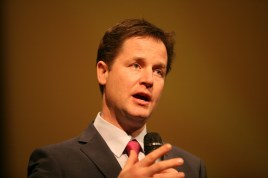 Clegg was backed up this week by constitutional expert Professor Vernon Bogdanor who told an Association of European Journalists lunch that it isn’t a legal text. He also challenged assertions that once started the Article 50 process was irrevocable although he wasn’t hopeful on the prospects of a second referendum: “A second referendum would only be possible if there is a major shift in public opinion. That would take some major concessions on free movement to be offered which looks unlikely”.
We’ve got one year, not two
The other point on which both Clegg and Bogdanor agreed was the short window there will be for proper negotiations.
With France, Holland, Germany and, probably, Italy distracted by national elections, serious talking is very unlikely to start before the autumn now that Theresa May’s government has delayed so long in starting the Article 50 process. There will then be little over a year to get the main terms of the UK’s exit settled as the deal will have to go to both the UK Parliament and through the rather longer approval process in Europe, involving the Commission, Council of Ministers and European Parliament.
Clegg’s redemption
As a footnote, let me praise Nick Clegg. I have made no secret of my view that he was a poor leader of the Liberal Democrats and ineffectual as Deputy Prime Minister. Brexit, however, is an issue on which I have heard him speak a few times and he is spot on in his analysis, prognoses and fears. He clear, sincere passion on the topic is making people listen to him and we will all be better for doing so.

I’ve commented before on how the modern author has to be a marketer as well as a researcher and writer. For me that phase is still building momentum as I get more invitations to speak about my book, Fighting for the Empire, the amazing story it contains and the extensive research that went into pulling such a complex story together.
As well as invitations to speak to specialist groups such as the Brentwood Military History Book Club, I have decided to be bold and put on a public talk next month. This takes place on Tuesday 7 March at Brentwood Cathedral Parish Hall, starting at 7.30pm. I’ve entitled it From Galway to Empire as an audience drawn partially from the many people I know in the congregation at Brentwood Cathedral should be particularly interested in Kelly’s Irish Catholic routes.
However, it will also look at the extraordinary range of conflicts and adventures he was involved in, many of them illustrated by unique photographs and documents from family collections. For those interested in the artifacts from the Kelly story I’ll be bringing along some of the albums, his wife’s fascinating collection of autograph books from WW1 and his ceremonial sword worn at the famous Delhi Durbar in 1911.
I’ll also be happy to answer questions about the research, how you build an authoritative story from a fragmented, largely oral, family history and how you go about getting it published.
Admission is free and 25% of the money from all books sold on the night will go to the Cathedral’s charity for 2017, Bridge2Aid.
If you are interested in the the two world wars, India, Ireland, Empire history, military medicine and the Merchant Navy they’ll be something in the talk for you.
If you would like me to come and talk to your organisation have a look at the range of topics I can cover.
Fighting for the Empire is available direct from the distributor Casemate and Amazon. It is also available through all bookshops.
Brexit continues to divide the country. The cancer of ignorance and intolerance unleashed by last year’s referendum shows no sign of receding. It has poisoned political discussion and debate to an extent I cannot recall in my many decades following, being involved in and writing about politics.
The Supreme Court decision yesterday that Parliament must have the initial say in triggering the Article 50 process to leave the European Union has just stirred the whole malodorous pot further.
Let’s look at some of the nonsense being spouted today by those so blindly in favour of leaving the EU.
First, the demand that Remainers mustn’t use the Supreme Court decision to delay Brexit.
So far, the delay has all been as a result of the dithering of a Prime Minister and a government who until last week couldn’t get beyond the ridiculous mantra of “Brexit means Brexit”. It will be a full nine months from the referendum before serious negotiations start and responsibility for that long delay must be laid firmly at the door of 10 Downing Street.
The irony of this is that the threat of a further delay if Parliament prolongs the Article 50 debate could have been avoided if May hadn’t dithered so long. There was an opportunity to start the Article 50 process immediately after she was installed as Prime Minister. Opponents of Brexit were in disarray, the legal challenge in its infancy and the pressure from Europe to get on with it quite intense. She could have done it without consulting Parliament. It would have been wrong to bypass Parliament but she could probably have got away with it.
What is being watered down?
Similarly, the defiant noises about not watering down Brexit are rather nonsensical. Precisely what is in danger of being watered down? Until last week when May sketched out a route map towards a hard Brexit nobody had a clue what sort of Brexit we were looking at. The trouble with this plan is that it is very vulnerable to legitimate challenge. All the way through the referendum campaign the leaders of the Leave campaign were at pains to stress they were not looking to leave the Single Market. They constantly talked about the Norwegian option as being the most attractive to the UK. That would mean remaining part of the Single Market through membership of the European Economic Area.
Watering down May’s hard Brexit option to retain access to the Single Market is surely much closer to what Farage, Johnson, Gove et al campaigned for? It is hardly the fault of Remainers that they conveniently forgot that EEA membership also means accepting the free movement of people.
Finally, we come to the dramatic threats around the consequences of thwarting the “Will of the People”. These go far beyond the merely nonsensical: they are hysterical and dangerous.
Tyranny of the Majority

Over 16m voters still want to be part of the EU
We seem to be in danger of forgetting that the result of the referendum was very close. Almost half of those who voted were in favour of staying in the EU. Those 16.14m people have a voice too in a pluralist democracy. We are in grave danger of turning the “Will of the People” into the “Tyranny of the Majority”. Like all tyrannies that is already showing itself to be intolerant, brutally ignorant, dismissive of democratic processes and the rule of law.
That is not a Britain I feel very comfortable in.
So, where to we go from here?
Parliament now has a say and it should insist on the fullest possible information on the government’s strategy and objectives. I would prefer if the final decision was also made by Parliament but I fear the tone of the debate and the myth that the Brexit lobby has built up about the legitimacy of the referendum means that the final terms should also be submitted to a plebiscite. That guarantee should be sought now, as Tim Farron and the Liberal Democrats have urged.
Brexiteers should welcome a second referendum
Those who want to leave the EU should welcome this, not decry it. Victory for them in a second referendum to endorse the outcome of the negotiations would legitmise their cherished objective of a United Kingdom outside the EU. Are they such faint hearts that they doubt whether the British people will buy what looks increasingly likely to be a hard Brexit? Surely, they are made of sterner stuff than that?
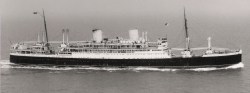
Christmas Day 1942 for Thomas Kelly was celebrated on board the troopship Rangitata, making its way up coast of south America to New York to collect American troops coming to Europe.
The Rangitata left the Clyde in August 1942 as part of one of the Winston Specials convoys taking the 8th Army to North Africa. On its return journey it was sent with additional troops to reinforce Diego Suarez on Madagascar, which had recently been seized from the Vichy French to prevent it being used as a base by the advancing Japanese forces. While there it collected a troop detachment to take to Mauritius.
It then eventually continued as originally planned to Uruguay and Argentina to load up with food to bring back to the UK but was then unexpectedly diverted to New York. These various diversions meant that Kelly missed his daughter Rosemary’s wedding in London on 11 January 1943.
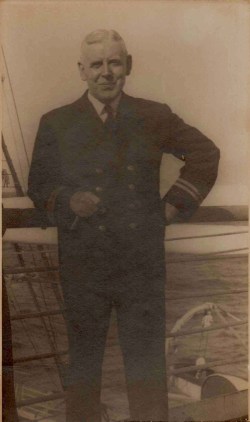
Kelly continued serving on troopships and Atlantic convoys until the middle of 1944 when, aged 74, he returned home to London.
His wife Gertrude for the first time in her married life then enjoyed an unbroken period with her husband. As well as the arrival of grandchildren there was the novelty of being together to celebrate a succession of landmarks in their lives: his 75th birthday in March 1945, her 60th the following year and their 30th wedding anniversary in April 1948.
This happy postlude came to an abrupt end on 29 January 1949.
While shaving at home in Paddington Kelly suffered a massive heart attack. The curtain was thus lowered on a life of adventure, courage and service to country and his fellow human beings of many races.
The Kelly story is told in Fighting for the Empire.
Follow his remarkable life through 12 Christmas Days.
Previous: No 11, London 1939
The Kelly family spent the first Christmas of the Second World War together at their new home in Paddington, having left Jersey the previous year as the storm clouds of WW2 gathered.
Kelly may have been almost 70 at the end of 1939 but his mind was turning to the war and, in particular, how he could serve the British Crown once more. He initially volunteered for service with the Royal Navy but was rejected on grounds of his age so he turned his attention to the Merchant Navy instead. By February 1940 he was on board the SS Madura as Ship’s Surgeon and would soon find himself being dive-bombed in Bordeaux harbour.
He spent almost the whole of WW2 at sea.
The Kelly story is told in Fighting for the Empire.
Follow his remarkable life through 12 Christmas Days.
Next: Come back tomorrow!
Previous: No 10, Jersey 1936
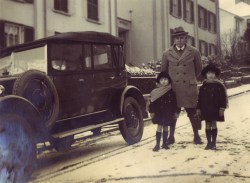
Thomas Kelly’s 30 year service with the Indian Medical Service came to an end in the summer of 1926 and by Christmas Day that year he was with his family in their new home in Jersey.
He signed up as a ship’s surgeon with the Royal Mail Steam Packet Company and by Christmas had already completed one two-month voyage to South America on the 900-passenger liner SS Orduna. This was the start of a regular engagement with the shipping line (which was about to become the Pacific Steam Navigation Company – PSNC) and he spent two to three months every year for the next decade either on the Orduna or its sister ship the Orbita, increasing the number of voyages he undertook later in the 1930s so that he was then at sea for most of the year.
His daughter Rosemary (pictured on the left with her father and late sister Brigid) saw snow for the first time that Christmas.
The Kelly story is told in Fighting for the Empire.
Follow his remarkable life through 12 Christmas Days.
Next: Come back tomorrow!
Previous: No 9, Rawalpindi

Thomas Kelly’s life changed dramatically after the First World War as he married and quickly had two daughters, Brigid and Rosemary, both born in India. He had also managed to serve in another war – the 3rd Afghan War in 1919.
After visiting the UK and Ireland on leave with his new family in 1922, they were back in India by Christmas at home at 2 The Mall, Rawalpindi. He was Commanding Officer of all the Indian Army hospitals in that part of India (now Pakistan).
He was contemplating another move, this time to Lahore where he took up the post of Commanding Officer of the Indian hospitals in January 1923. His status and reputation also earned him an appointment as Honorary Surgeon to The Viceroy, by now Lord Reading, the former Rufus Issacs who had served as Attorney-General in the pre-war Liberal government. This would have taken him and his wife, Gertrude, to many government functions at Delhi and Simla, especially after his promotion to full Colonel later that year.
The Kelly story is told in Fighting for the Empire.
Follow his remarkable life through 12 Christmas Days.
Next: No 10, Jersey 1926
Previous: No 8, Mesopotamia 1917


