
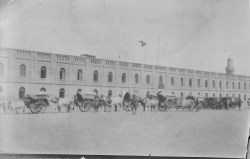
Kelly was still in Nasariyah in 1917 but now confirmed as a Lieutenant Colonel and in command of the 1000-bed 83rd Combined Stationary Hospital and its field units spread along the Euphrates towards Baghdad.
Christmas Day 1917 was celebrated in some style with choice of curried chicken, duck or roast beef with Yorkshire pudding for all the staff and patients not on a special diet followed by plum pudding, stewed peaches with cream or fruit jellies. The Indian staff and patients were also offered an extended menu for the day, which finished with a concert in the evening. Life was clearly much more relaxed in the cool, damp winter weather with the Turkish forces no longer posing any threat. The previous summer had seen record temperatures causing major problems with severe heatstroke.
The 46 year old Kelly was soon to be awarded the Distinguished Service Order for his role in the aftermath of the Siege of Kut and was about to propose to Gertrude Fenn, a nurse from Essex, who served at the 83rd CSH earlier that year.
The Kelly story is told in Fighting for the Empire.
Follow his remarkable life through 12 Christmas Days.
Next: Come back tomorrow!
Previous: No 7, Mesopotamia 1916
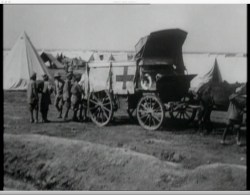
The 105th Indian Field Ambulance had been on active service for over two years by time Christmas Day 1916 approached and was now based in Mesopotamia (present day Iraq), still with Thomas Kelly as its commanding officer.
It had been sent from Egypt to Aden where it was a the centre of fierce fighting. In early 1916 it arrived in Mesopotamia to help with the appalling crisis in the aftermath of the infamous siege of Kut, one of Britain’s great military disasters. Thousands of sick and wounded had to be evacuated and the 105th IFA was flat out for months.
By Christmas Day 1916 things had calmed down and it had moved to Nasariyah on the Euphrates River and been re-designated the 105th Combined Field Ambulance.
For the first time since the war started Kelly recorded in the official War Diaries that they were able to celebrate Christmas with some modest entertainment – improvised by themselves – and a Christmas lunch, albeit lacking anything that resembled a traditional Christmas meal back home. It was, however, a far cry from the horrors of the aftermath of the fall of Kut six months earlier.
The Kelly story is told in Fighting for the Empire.
Follow his remarkable life through 12 Christmas Days.
Next: No 8 – Mesopotamia, 1917
Previous: No 6 – Egypt, 1914

Acting Lieutenant Colonel Kelly was commanding officer of the 105th Indian Field Ambulance on the Suez Canal on Christmas Day 1914.
He had been on only his second period of leave home to Ireland since 1897 when war was declared and was immediately recalled to India. Already a Major he was promoted so he could take charge of a large medical unit and was quickly on his way to Egypt with them.
By December 1914 they were stationed at Ismalia on the Suez Canal, soon to be the front line as the Turkish Army launched a major attack against Egypt. Kelly was determined his unit would be ready when the fighting started. He was so concerned about the challenges of moving casualties from the first aid posts he had established along the long frontline to the field hospital that he even arranged a training exercise for Christmas Day 1914.
It proved worthwhile as the fighting erupted early in February and Kelly’s unit was in the thick of it, winning praise for its efficiency, including for coping with large numbers of Turkish casualties. He was Mentioned in Dispatches for his part in the fighting.
The Kelly story is told in Fighting for the Empire.
Follow his remarkable life through 12 Christmas Days.
Next: No 7 – Mesopotamia, 1916
Previous: No 5 – Iran, 1906

Captain Thomas Kelly, now in his mid-30s, spent Christmas 1906 in the remote province of Seistan in Persia (present day Iran). There his one task was to stop an outbreak of the plague spreading to India.
It was dangerous. Previous medical officers had caught the disease and died. The tiny British consulate in Nasratabad was attacked by a 500-strong mob claiming claiming Kelly was burning the Koran – an incident reported in newspapers around the world.
But they were British and had standards as Swedish explorer Sven Hedin noted when he stayed at the consulate:
“Six Englishmen, without ladies, were staying in Seistan, and with them I spent nine memorable days. Englishmen have a knack of making themselves at home in whatever part of the world their lot may cast them, and even here in this wretched Nasretabad they lived much as in London. They did not come unshaved to luncheon in the great saloon, and at dinner they appeared in spruce attire, with starched shirts, dinner jackets, and patent leather shoes. And then we sank into the soft armchairs, and took coffee, with prime cigars, and, while the gramophone reminded us of the divas and tenors of the great world, whisky and soda were served, and we talked of Iran, Tibet, and the plague. We were in high spirits; and it was difficult to believe that all the while the angel of death was roaming about in search of his hapless victims.”
We can imagine they ensured Christmas Day 1906 was celebrated with some style.
It took two years but Kelly rid Seistan of the plague.
The Kelly story is told in Fighting for the Empire.
Follow his remarkable life through 12 Christmas Days.
Next: No 6 – Egypt, 1914
Previous: No 4 – Tibet, 1903

Thomas Kelly found himself deep into Tibet on Christmas Day 1903 but with a decent meal and a ‘Best Beard’ competition to take his mind off the hardships he faced. He was a medical officer on the Tibet-Sikkim Mission, sometimes called the Younghusband Expedition, although not by Kelly who loathed Francis Younghusband.
Kelly’s medical unit crossed the Himalayas and arrived at the main expedition base at Chumbi on Christmas Day 1903, just in time to enjoy the one break he was going to have from the monotonous diet of porridge, mutton stew, biscuits, jam and chapatis with the occasional ration of butter. The officers at Chumbi sat down to a Christmas dinner of turkey, ham, plum pudding, mincemeat, cake and champagne, which must have tested the supply lines to the limit. The champagne arrived almost frozen, however, not something that would have bothered Kelly as a teetotaller. This was to be the last culinary treat for a long time as Charles Allen comments in Duel in the Snows: “Almost ten months passed before any of those present enjoyed another meal even half as good”.
Firewood was in short supply and was limited to cooking so the men, officers included, had to rely on the many layers of winter clothing they had been issued to keep warm, much of it not removed for days on end. Just about every man abandoned shaving, prompting the commanding officer General Leslie Macdonald to jokingly offer a prize for the best beard by Christmas. Unfortunately, we don’t know who won the prize.
The picture shows Kelly – with beard – back right. General McDonald is seated centre.
The Kelly story is told in Fighting for the Empire.
Follow his remarkable life through 12 Christmas Days.
Next: No 5 – Iran, 1906
Previous: No 3 – Chitral, North West Frontier 1900
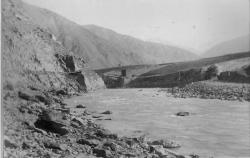
Christmas Day 1900 would definitely have been a White Christmas for Thomas Kelly
He was now a captain and doctor in the Indian Medical Service, having arrived in India at the beginning of 1897. On Christmas Day 1900 he was serving as senior medical officer with the Chitral Field Force, based high up in the notorious mountain passes between Afghanistan and India (now Pakistan), including the Khyber Pass. He was attached to the 2nd Regiment, Central India Horse, an Indian regiment, and had already mastered Urdu and Hindi.
On the North West Frontier he experienced at first hand the indiscriminate, sudden attacks that rebel tribesmen launched on British and Indian forces and lived with the constant threat of sniper fire, especially when travelling on horseback between the two mountain bases Drosh and Chitral, a day’s journey. Even medical officers were armed on the North West Frontier and Kelly frequently slept with his pistol under his pillow.
One bonus of a posting in such a remote region was the access to local game and as a fine horseman and frequent hunter there is no doubt the Kelly would have helped ensure a hearty meal for the handful of British officers at Chitral on Christmas Day 1900.
The Kelly story is told in Fighting for the Empire.
Follow his remarkable life through 12 Christmas Days.
Next: No 4 – Tibet, 1903
Previous: No 2 – Queen’s College, Galway 1890

The bustle of 20 years earlier was all gone by the time Thomas Kelly was 20 and Christmas Day 1890 was celebrated with just his widowed mother, still living at 2 High Street.
Kelly was by now a final year scholar studying medicine at Queen’s College, Galway with a career in medicine beckoning.
The 1880s had been a dramatic decade for the Kelly family. His father died in 1883, a broken man after a controversial involvement in the brutal world of Galway politics. Another brother, Denis, to whom Thomas was very close, had decided to head off to Bendigo in Australia to join other members of the family. His eldest brother James, who ran the tea merchant business after his father died, passed away aged 44 in 1889 and a few months later his sister Annie entered the Presentation Convent in Galway where she was to spend the rest of her long life.
Further tragedy stuck in November 1890 when his 27 sister Maria died, leaving a young son Denis Valentine Morris. Denis followed his uncle into medicine, mentored and supported financially by Thomas.
Christmas Day at 2 High Street in 1890 must have been a subdued affair.
It was also to be one of the last Thomas Kelly would spend in Ireland.
The Kelly story is told in Fighting for the Empire.
Follow his remarkable life through 12 Christmas Days.
Next: No 3 – Chitral, North West Frontier 1900
Previous: No 1 – Galway 1870
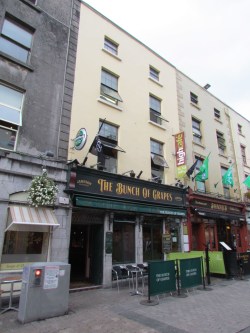
Thomas Bernard Kelly’s first Christmas as a nine-month old baby was spent at the family home above the tea merchants at 2 High Street, Galway.
It would have been crowded as the large family gathered for Christmas lunch after returning from Mass at the Pro-Cathedral where his parents had been married in 1844. Baby Thomas was the youngest of ten children at that stage although his 42-year old mother, Bridget, was almost eight months pregnant: John Philip was born the following February but died less than a year later. This wasn’t the only child she lost in infancy so by 1870 there would have been eight children living in the tiny rooms above the shop: another, Catherine, had joined the Sisters of Mercy and left for life in a convent in Paris a few years before.
This was the last Christmas such a large gathering of the Kelly family took place at 2 High Street. The following year, his 21 year old sister Margaret – who must have taken much of the burden off her pregnant mother that Christmas Day – and 17 year old brother Michael left to join his mother’s Considine relatives in Bendigo, Australia.
They would never see their baby brother again, although through letters and the newspapers they followed his adventures from Down Under.
The picture shows 2 High Street as it is today.
The Kelly story is told in Fighting for the Empire.
Follow his remarkable life through 12 Christmas Days.
Next: No 2 – Queen’s College, Galway 1890

Thomas Kelly lived a life of service and adventure through two World Wars, the Indian Raj, Imperial expeditions and World War Two convoys.
That remarkable story is told in full in Fighting for the Empire but a glimpse of where he was on 12 Christmas Days through that action-packed life offers a colourful flavour of his story.
Many readers will have relatives who selflessly served in these conflicts too so these stories and Fighting for the Empire hopefully give them some insight into how their relatives lived and how they celebrated Christmas.
No 2 – Queen’s College, Galway 1890
No 3 – Chitral, North West Frontier 1900
David Worsfold talks about the Kelly story
Fighting for the Empire is available direct from the distributor Casemate, also from Amazon. It is available through all bookshops. In Ireland it can be ordered through Kennys Bookshop, Galway

I had a nightmare earlier this year in which I foresaw the United Kingdom voting to leave the European Union, Boris Johnson becoming Prime Minister and Donald Trump being elected President of the United States. A I woke from that nightmare, like most people, I laughed it off as an implausible triple whammy.
Wind forward a few months. Brexit is with us, Johnson is Foreign Secretary and Trump is President. That’s 2.5 out of three on the nightmare scale. Now I am no longer dreaming but looking into the next year and seeing huge potential for worse to come.
Many millions of words have already been written trying to understand Brexit and Trump and many millions will follow before we fully understand the reasons for those unexpected events and their consequences. One thing we do know is that there is a rising tide of nationalism across the western world, with rejection of globalisation and established political orders at its heart. Many commentators describe this phenomenon as populism but that seems far too comfortable a word to describe something that has inescapably sinister undertones.
Whatever labels we apply to this phenomenon it is a grim reality and is gathering force. Casting an eye across the horizon of the next 12 months should be enough to give any progressive liberal nightmares. Destiny seems a grand word to apply to what is going but I believe the destiny of the world is now in the balance to a degree that it hasn’t been since the darkest days of the Cold War in the early 1960s.
2017 – Diary of Destiny
- 4 December – Italian Constitutional Referendum
- 20 January – Inauguration of President Trump
- 15 March – Dutch Parliamentary Elections
- March – UK triggers Article 50
- 23 April & 7 May – French Presidential Elections
- Between 27 August and 22 October – German Federal Elections
Each of those events has the potential to generate huge political turmoil.
Italian Constitutional Referendum
Prime Minister Matteo Renzi failed to get an ambitious package of constitutional reforms aimed at ending the chronic instability of Italian governments – of which their have been 63 in 70 years since the birth of the Republic – through Parliament. He has been forced to hold a referendum and has said he will resign if they are not passed. At the moment the reforms look unlikely to succeed. Another general election could see the internet-based Five Star Movement led by comedian Beppe Grillo making significant gains.
Inauguration of President Trump
By the time Donald Trump gets to make his Inauguration speech we will know what his government looks like and should have a much clearer idea of his early priorities. Will he moderate many of his most outrageous policies? It almost doesn’t matter if he does as he has already changed the mood of American politics and society for the worse.
Dutch Parliamentary Elections
The Dutch elections will almost certainly see a change of government as support for Prime Minister Mark Rutte’s Labour Party (PvDA) has collapsed from 40% at the last election in 2012 to around 10%. The main beneficiary has been the right-wing, anti-immigrant Party for Freedom (PVV) led by Geert Wilders which has led in the opinion polls for most of 2016. In government or as the main opposition party in a hung Parliament the PVV could force through a referendum on Dutch membership of the EU which it opposes.
UK triggers Article 50
Prime Minister Theresa May has said this will happen in March 2017 regardless of the decision of the Supreme Court and any subsequent need for a vote in Parliament. In the run-up to that we should get some clarity on the government’s negotiating stance and whether issues around access to the single market passporting for financial institutions and restrictions on free movement of people are likely to form any sort of red line in the negotiations.
French Presidential Elections
At the moment the only certainty is that the Front National candidate Marine Le Pen will poll very strongly, almost certainly making it through to the second ballot as her opponents are still in some disarray. The FN is a fiercely nationalist party which has opposed the European Union since the party was launched in 1993. A Le Pen presidency could mark the end of the EU and totally change the terms of the Brexit debate. This has to be the most disturbing element of the 2017 nightmare.
German Federal Elections
There has been a steady growth in support for Alternative für Deutschland, a rightwing party opposed to the Euro and further European integration but not currently advocating that Germany leave the EU. It has been picking up seats across Germany in state elections and is currently on course to win its first seats in the Bundestag, easily crossing the 5% threshold. This could destabilise Angela Merkel’s grand coalition.
Six key moments of uncertainty over the next year. Brext and Trump were both easily dismissed as threats earlier this year. No-one can afford to make the same mistakes again. We must start speaking out against the evil of intolerant nationalism and thwart its march at every turn. Being melee-mouthed and accommodating has no place anymore. That was tried in the 1930s and look where that ended.
I’m not saying we are heading for a war but we are certainly entering a very dark phase in the history of western democracy.
ENDS


