
State support of the insurance industry? In Conservative Britain in 2016? Unthinkable? To many people the questions might stop there – but they shouldn’t.
The state already stands behind the insurance industry in several key areas and there are suggestions that it should do more, especially helping extend the availability of affordable flood insurance to small businesses, leaseholders and others not covered by Flood Re and to facilitate the provision of insurance for an ill-defined basket of cyber risks.
Of course, the Treasury already ultimately stands behind Flood Re although with mechanisms to pass most of the costs back to the insurance industry, but this is no isolated example of government intervention in insurance in the UK when the market fails. For many years there has been a Treasury-backed reinsurance guarantee for long-term export credit insurance and terrorism cover was abandoned by the commercial market in the mid-1990s and replaced by Pool Re.
 All of these seemly unrelated areas have the common feature of risks that have become too large, too difficult to quantify and measure using traditional underwriting and pricing mechanisms. In short, the market has failed in these areas and so the state has – very reluctantly – stepped in, albeit keeping its involvement at as long an arm’s length as it can.
These challenges are not going to go away or diminish in scale and scope. We live in an increasingly volatile, unstable world and one where risks are getting more concentrated and bigger by the day. Many of these risks are growing beyond the ability of established insurance mechanisms to cope with. Yet, in almost all cases, commerce and society can’t function effectively without the back-up of insurance.
You can add into this mix the challenges of providing affordable, accessible health and social care to aging populations, a clear example of current public and private sector failure.
I don’t know what other risks will be next to be added to the list that insurers and reinsurers feel unable to manage but I do know that climate change, geo-political instability, terrorism, the growth of mega-cities, mass migration, dependence on technology and changing demographics will all play a part in creating risks that are beyond the capability of the insurance industry to underwrite without threatening its own existence.
We need to find a new settlement between state and the private sector that acknowledges the extent of these threats and the complete absence of mechanisms to cope with them. I am not optimistic as we have a government that sees only a diminishing role for the state and an insurance industry reluctant to be be realistic in acknowledging its limitations.
I have been struck when reading and listening to the tributes to Pierre Boulez, who died this week aged 90, by the frequent references to the hostility to his music and his assaults on the stale repertoire of the London and New York orchestras in the 1970s. People may take away from some of the tributes the belief that he ploughed on regardless and cared little about whether people appreciated what he was trying to achieve. That was far from the case.
I was fortunate to spend most summers in the 1970s attending the Proms almost nightly, during the period when Boulez was at the height of his powers and influence in London as Chief Conductor of the BBC Symphony Orchestra. With his ally William Glock, who was Controller of Music at the BBC and in charge of the Proms, he took the Proms programme by the scruff of its neck and through the force of his personality and passionate, persuasive advocacy built an audience for his music and that of his contemporaries. He also championed many neglected masterpeices and brought a refreshing clarity to established works such as Mahler’s mighty 8th Symphony.
An audience in tune with him
He struck up a warm rapport with those of us who stood behind him at the front of the arena in the Royal Albert Hall – in those days a predominantly youthful group – as he could see we approached his project with an open mind. In those days some of the performers, including star conductors such as Colin Davis and Bernard Haitink, would occasionally join the Promenaders for at drink at the Queen’s Arms. Sometime in the mid-70s I, with a couple of friends, decided it was time to ask Boulez if he would join us. Everyone told us he would never come, that he was intensely private, not a man of the people and so on.
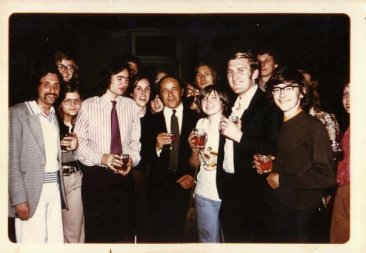
Boulez at the Proms: the great man in the centre with yours truly (with hair!) on his right
We did ask and he readily accepted, relishing the opportunity to enjoy the enthusiasm we had for what he was doing and his determination to remain true to his principles regardless of what the more snobbish, conservative music critics and audiences thought. The picture taken on one of those occasions captures the very genuine warmth he felt for a supportive audience.
He largely succeeded in his mission.
I remember when he first revived Schoenberg’s Gurrelieder, a massive work requiring vast orchestral and choral forces. The audience that night was thinly spread around the vast spaces of the Royal Albert Hall. By the time he repeated it a year or two later, the hall was nearly full as he produced another beautifully crafted performance, controlled as ever without any podium histrionics and without ever using a baton.
He also gradually built an audience for his own music which we came to understand more through him. Works such as Rituel: in memoriam Maderna and Répons were enthusiastically received at the Proms. Also, later, when he brought his avantgarde group Ensemble Intercontemprain to the Proms the audiences were both large and receptive, almost unthinkable a decade or so earlier.
A debt we all owe to him
Concert programmes now are more adventurous than they were before Boulez, with Glock and the BBC, embarked on their bold mission over 40 years ago. We are in their debt.
One of the presenters on Radio 3 this morning said “we will never see his like again”. My initial reaction was to agree with that but then a moment’s thought made me think otherwise. I fervently hope we do see more like him, although they will grace our lives infrequently.
We need people like Boulez, who unflinchingly challenge conventions with an intellectual rigour and passion in music, the arts and the wider world.
The relentless heavy rainfall across the north of England is calling into question our entire approach to water management, flood risk, flood defences and flood insurance. The last few weeks have changed the game so dramatically that you have to question whether Flood Re – the joint insurance industry and government initiative to provide cover to the most flood prone domestic properties – is already doomed.
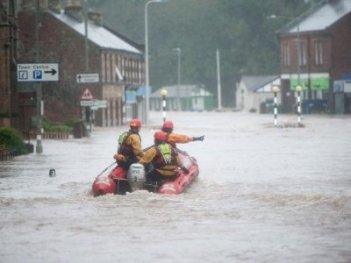 If Flood Re had already been up and running as was originally intended it would be financially stretched, possibly relying on government support and almost certainly having an industry whip-round in the form of a second levy bail it out. The insurance claims from the current flooding are already estimated to be a minimum of £1.5bn, although part of that will be from commercial properties which Flood Re won’t cover, contrary to what the BBC and other national media outlets were suggesting this morning. Even so, we have to assume that many, if not most, of the domestic properties affected are in high risk flood areas and would therefore have been passed by the mainstream insurance industry to Flood Re. Without years to build up reserves from the levy that will be imposed on all household property insurance policies Flood Re would be pushed to pay the claims that would now be coming its way and would be close to going through its reinsurance cover, expected to be set at £2.1bn. With no levies squirreled away in reserves it would have to look elsewhere to find the money to respond to a disaster on this scale. That could be the trigger for an additional levy on all insurers ceding policies to Flood Re.
That was before everyone started to acknowledge that the severity of the current flooding will prompt a complete reassessment of flood risk. It will mean many more homes being added to the hundreds of thousands of the most vulnerable high risk properties that Flood Re will be expected to cover. The length of time it is taking to get the current modest project up and running suggests that to ask it to cope with a much expanded portfolio will be expecting too much.
Businesses face insurance crisis
Then, there will be the increasing pressure on the insurance industry to ensure that small businesses in flood prone areas can find affordable insurance. The claims that the market is providing this at the moment are not supported by the stories coming out of the north of England. Many small business are saying they are uninsured, or subject to huge excesses that effectively render insurance useless. This was always a weakness of the Flood Re scheme. It was clear from the start that it should have been extended to cover small businesses. The pressure on the government and insurance industry to ensure small firms can find affordable and effective insurance cover will now intensify. Flood Re is not set up to provide the answer and to look to it now to take on commercial properties would set it back months.
It is hard to have much confidence in Flood Re as a solution to the huge challenge of providing flood insurance to domestic and commercial property owners in this dramatically changed world. It was always a limited solution to a very restricted view of the problem and many will judge it harshly when it proves not to hold the magic wand flood victims hope for.
The Oldham by-election result had political correspondents and doomsayers in the Labour Party scrabbling to find a new script today. Most had already written their stories and started penning Jeremy Corbyn’s political obituary on the assumption that we would see a narrow Labour victory after holding off a strong UKIP surge.
Oh Dear: how wrong they were.
All day they have struggled to understand, let alone explain what happened. Many seized on Nigel Farage’s assertion that 11,000 dodgy postal votes spiked UKIP’s guns before it slowly dawned on them that whatever might be wrong with the way postal and proxy voting currently works it was embarrassing to be caught sharing UKIP’s pathetic fig leaf.
 This happens so often when political correspondents are forced to step outside the Westminster bubble, especially after the dramatic week we have just witnessed in Parliament. On Wednesday evening they were ready to write how Hilary Benn was about to topple Corbyn: they just needed the expected narrow win in Oldham to press the publish button. Had they looked beyond the narrow confines of London SW1 they might have steadied their hand and injected a little more balance into their interpretation of events.
Oldham confirms what has been happening over the last two months in local authority by-elections. Labour has been doing well in its heartlands, showing that the enthusiasm that swept Corbyn into the leadership at the end of the summer was not temporary and has not dwindled. They also show that Labour is not doing so well elsewhere: Corbyn appeals to the loyalists but has yet to build a narrative that reaches beyond that base.
Awkward for UKIP too
The results also show that support for UKIP is slipping as they, too, are struggling to build a new narrative following the painful General Election result for them. With only one MP they won’t get the attention at Westminster their substantial electoral support justifies until they find a way of countering the clever, but fragile, position David Cameron has adopted on the European Union renegotiation and referendum. The debate appears to have moved but UKIP hasn’t.
People expect to be able to follow major events as they happen whether that be breaking news stories, Test Matches or industry conferences. This means that live blogging is now an essential skill for the modern journalist.

Live blogging: easier than you think
It should be almost instinctive for a good news journalist but it is surprising how many find it challenging or dismiss it. Some are fearful of the technology, others think that it gets in the way of ‘real’ reporting while for others it is probably just too much effort. Such flimsy excuses shouldn’t be accepted by editors or publishers. Live blogging from events should be a standard component of the content on any new-driven website, even for specialist B2B markets.
It isn’t difficult.
You can start with a simple, free platform like Twitter and create a feed from an event using a hashtag so everyone can find it easily and also so you can curate it afterwards. Two of the biggest objections I come across to live blogging are easily overcome this way.
The first is that it gets in the way of taking notes so you can write a proper report later. My answer to that is simple: use Twitter as your note book. Capture the key quotes you want to use and share them with everyone else. If there are several people using Twitter at an event you’ll even be able to check across to their Twitter feeds to see what caught their attention, helping you to fine tune the story for your readers.
Curate your content
The second objection is that it is a lot of effort for something that is so transient. That’s an easy one to overcome. Use a tool like Storify to curate all the relevant social media content and create a permanent record of the event so the reader who missed out live can catch up on everything as it happened at their convenience. Here’s an example of one I created from an event yesterday – IFAA Educational Conference. There weren’t any other people Tweeting from the event which was disappointing but I have pulled in a few comments to add other voices. Had there been content on Facebook, Google+ and other platforms this could have been added too using Storify.
Twitter can be limited so you can take your live blogging to another level using tools such as ScribbleLive. This enables you to add longer content, breaking away from Twitter’s 140 character limit, as well as pulling in comments from social media, more pictures and multi-media content. It is easy to use and creates a deeper experience, especially if you want engagement with an audience as it allows commenting. I covered a whole day virtual event for Insurance Age recently using Scribble, mixing my own content with Tweets from various people watching the event.
People expect immediacy nowadays: publishers and event organisers need to respond to that.
• If you want someone to live blog your event or come in and train people how to do it themselves then contact me on 01277 221445 or david@worsfoldmedia.com
• See other Training courses run by David Worsfold
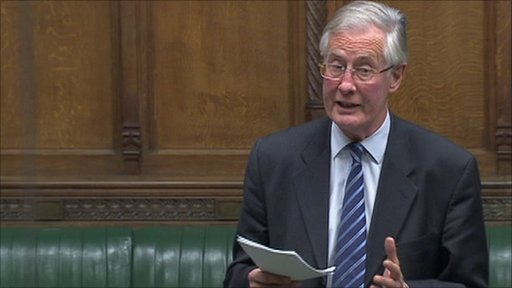
Meacher: respected figure shown little respect by his own party in death
The unseemly haste to get the Parliamentary by-election in Oldham West and Royton – caused by the death of Michael Meacher – underway is both unseemly and cynical. We have heard alot about a new style of politics since the election of Jeremy Corbyn as leader of the Labour Party but moving the writ for the byelection ten days before Mr Meacher’s funeral is as cyncial and old politics as it gets.
I am sure any readers who are students of British Parliamentary by-elections will tell me it has done before: it may well have been but that does not mean it is right. It shows a profound lack of respect for Mr Meacher, his achievements, his long service and his family.
Labour fear they may be vulnerable to a UKIP surge in Oldham and so wanted to give them as little time as possible to build up momentum, hence the haste to set a date for the contest. This will now take place on 3 December, just six weeks after Mr Meacher’s death. It could easily have waited until after Christmas as by time the new MP is sworn in Parliament will be off for a recess anyway.
There was a risk in Labour’s strategy and that was that their selection process could have been dragged out, especially if it was very close and there was any scope for disputing the result. They seem to have avoided that trap as Jim McMahon, leader of Oldham council, was selected today with a substantial lead over his nearest challenger.
Mr Corbyn talks a very good game about a new approach to politics and likes to play it out in front of the cameras at Prime Minister’s Question Time but it needs to be backed by actions if it is to be convincing. So far, with cyncial ploys like this, he is not convincing me.

Europe or Asia? Where does Turkey’s future lie?
The news this morning that the talks about easing Turkey towards membership of the European Union are back on does not fill me with the same unquestioning cautious enthusiasm of almost every commentator I have heard or read today.
Turkey looks east far more than it looks west. it is not naturally part of Europe although I accept it is a crucial bridge between Europe and Asia. That does not mean it should be absorbed into the European Empire – sorry Union. The arguments I have heard this morning and in the past have uncomfortable echoes of the justification for the continued expansion of the British Empire at the end of the 19th century and the early part of the 20th century. Under the banner of Forward Policy expansionists argued that pushing further beyond India was necessary in order to secure its borders – how many times has that been said about Turkey this morning? British Imperial expansion was also regularly justified by reference to bringing freedom and economic prosperity to countries that were supposedly otherwise incapable of finding it themselves. Again, how many times has that been said this morning?
Dragging Turkey into the EU would be an act of Imperial expansion. It could also quite possibly make Turkey’s position with its eastern neighbours as even more intolerable as they would surely start to view it as a permanent enemy. Securing Europe’s borders might come at a terrible price for Turkey.
I am keen to see a debate about the future of Turkey and its relationship with Europe and Asia but it shouldn’t be conducted on the unchallenged premise that its membership of the EU would be a good thing. That principle needs much more rigorous examination first and not just from the right wing perspective of hating all things foreign and, especially all things EU.
It is a story that will run. Lord Ashcroft and Isabel Oakeshott knew that when they decided to include the uncorroborated allegation about David Cameron, a pig and strange initiation rites in their biography of the Prime Minister. It shocked me.
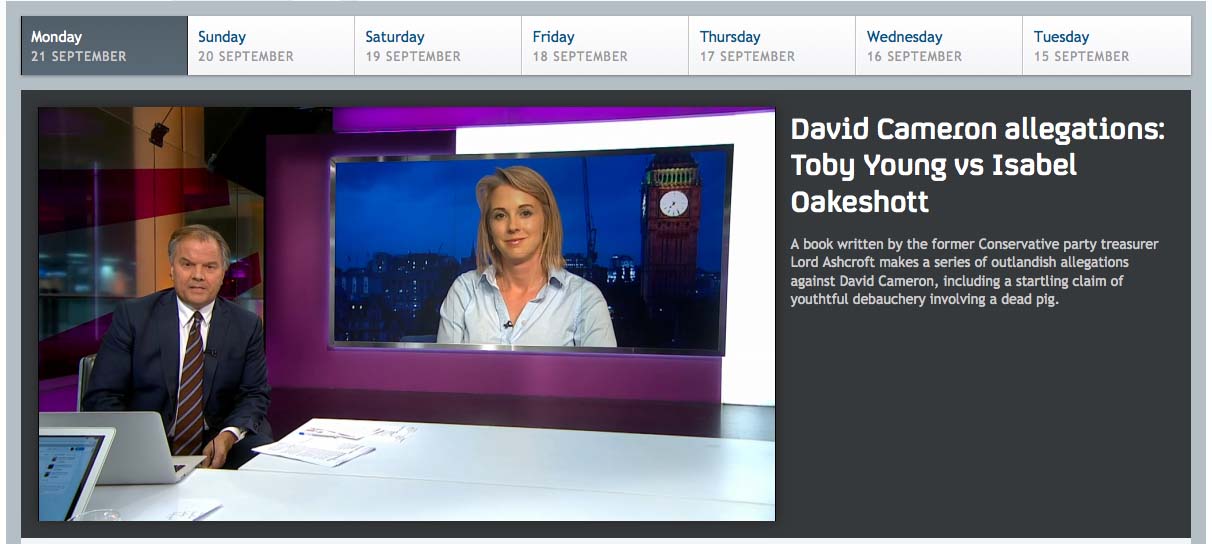
Channel 4 News: Oakeshott on the spot
It wasn’t the bizarre nature of the initiation ceremony that shocked me but the way a once respected journalist – Political Editor of The Sunday Times no less – could so casually abandon professional journalistic standards in order to help the bitter Ashcroft grind his axe.
The story has one unnamed source. It hasn’t been verified or checked against a second source, presumably because one couldn’t be found despite all their efforts. It also wasn’t put to Cameron before publication. These are essential procedures for professional journalists and the failure to follow these was put to Oakeshott on Channel 4 News last night and has also been raised by New Statesman on Ashcroft. Her glib dismissal of such concerns does her no credit.
They have taken a gamble. A gamble that Cameron won’t sue. They are probably right in that judgement but that still doesn’t mean they were right to publish.
Sink into the morass
Journalists come across all sorts of gossip in the course of their careers, much of it malicious and which can never be corroborated. It never gets published. You cannot rush into print the moment someone whispers something salacious in your ear otherwise you fall into the trap of doing someone’s dirty work for them, of taking sides and being a mere conduit and withdrawing from exercising any judgement. If journalists stop checking facts and giving people a chance to comment on them then they stop being professional. Crucially, they stop adding value for their readers. Once they do that they just sink into the morass of unverified content that washes around us from all sides in the digital era.
This promises to be a fascinating party conference season as the main parties – which now has to include the SNP and UKIP – contemplate a radically changed political landscape in the wake of the General Election.
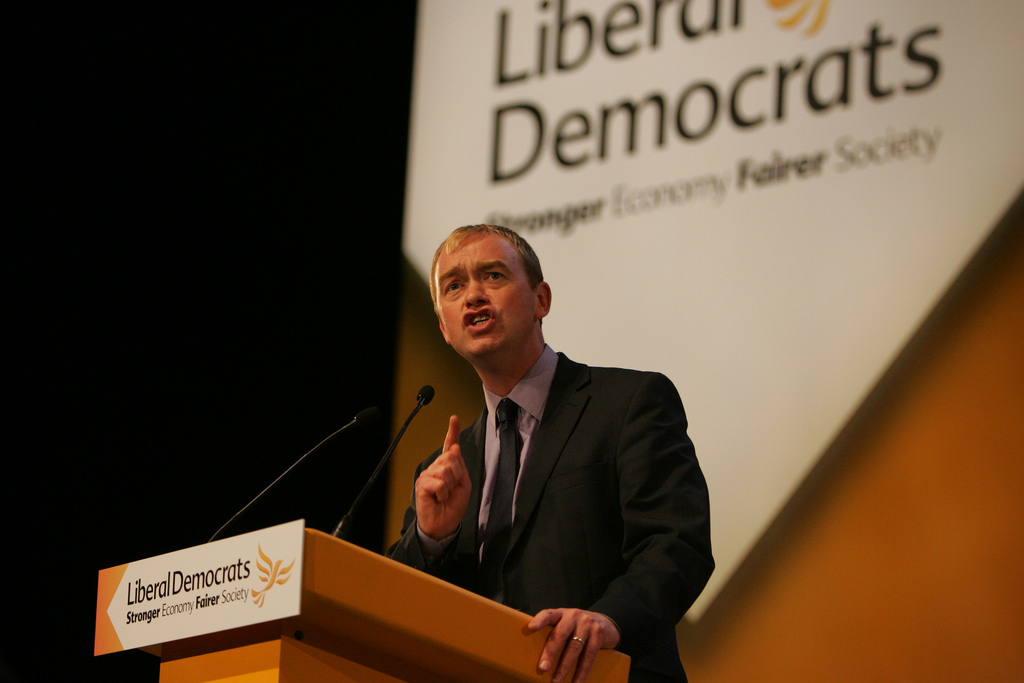
Farron: face left or stay centre?
First to gaze out across this new, uncharted landscape is the Liberal Democrats, one of the parties with a new leader at the helm, Tim Farron. He faces a bigger but potentially more promising challenge than he probably expected when he was elected to succeed Nick Clegg.
He knew he was taking on a party that will find it tough to come to terms with its abrupt return to the edges of Parliamentary politics. As delegates arrive in Bournemouth they will come face-to-face with some of the consequences of that with a huge drop in the external interest in their conference: fewer lobby and pressure groups, less attractive external speakers at fringe meetings and a greatly slimmed down exhibition. It is their new reality.
Picking the party up and giving it a new sense of direction was always going to be tough, especially as many influential figures can’t bring themselves to acknowledge how much damage the decision to form a coalition with the Tories in 2010 did to the party. It has cost them dear and there is an urgent need to distance themselves from the last five years. The party members showed some understanding of that awful leagcy by electing Farron over Norman Lamb, who would never have been able to shed the millstone of having been a minister in that government.
A man comfortable moving left
Farron was initially tempted to set out a path towards a more radical, left-of centre position. Instinctively that is where he feels most comfortable. It is also where the Lib Dems have lost most support, especially members, over the last five years. But the election of Jeremy Corbyn has further changed the landscape and left Farron with a dilemma. He must now be tempted to preach a more centrist message in keeping with the Clegg era, hoping that this will appeal to Labour supporters, possibly even a handful of Labour MPs, frightened by the sudden shift to the left the election of Corbyn represents.
Put Labour’s leftward realignment alongside the unleashing of the Tory right now they have a Parliamentary majority and the temptation to play the voice of moderation, sensible centrist card must be weighing very heavily with Farron and his advisers.
It would be a mistake to be tempted down that route. What I see in the new mood in politics is a desire among people for politicians to stand up for what they believe in, not to define themselves by reference to where others may stand. The Lib Dems suffered terribly in May because people no longer understood what they believed in after five years in a Tory-led coalition and a General Election campaign in which the core message was about being in the centre of wherever the other parties happened to be at the time.
Think longer term: the opportunities will come as Labour implodes
Farron should go with his instincts and move the party back to its former left-of-centre stance with radical policies that challenge the consensus on a range of topics. That may not instantly appeal to right-of-centre Labour supporters looking for an immediate safe haven but it will be a better medium term strategy. My guess is that the Corbyn leadership will implode at some stage in the next three years and the Blairites will reclaim the Labour Party. That will disillusion those attracted by Corbyn’s challenge to the way politics is conducted and by his advocacy of once unpopular causes but who are not totally sold on the hard-left philosophy that underpins his politics. Those people whose interest in politics has been rekindled by Corbyn’s victory will then be looking for a new home. That home was once and should always be the Liberal Party and its Liberal Democrat successor. If the Lib Dems are stuck offering a wishy-washy let’s not frighten anybody and be in the centre of whatever is going on elsewhere they will lose that opportunity.
They elected Farron knowing what he stood for and should let him lead according to what he believes. The worse that can happen is that some of the rightward leaning Orange bookers who have done so much damage to the Lib Dems decide that they really are Tories after all.
Left or Centre? That is Farron’s dilemma. We we find out over the next few days how he has faced up to it.
I was at the Proms earlier this week for a wonderful concert by the BBC Symphony Orchestra conducted by Edward Gardner which concluded with Janáček’s mighty Sinfonietta. It is impossible not to be gripped by the waves of sound produced by the vast army of brass in that piece. After some movements people were so impressed they applauded. You should have heard the grumbles which continued afterwards as we were walking down to South Kensington station from the Royal Albert Hall: “It’s not as if it was Tchaikovsky’s 5th” said someone in front of us in a patronising tone that beggared belief.
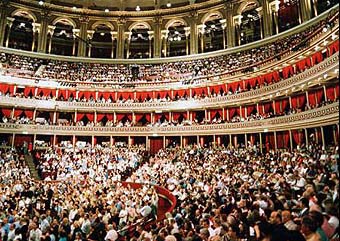
Music-lovers?: Proms audiences divide opinion
The ‘to applaud or not to applaud’ debate is a constant theme at classical concerts, especially those – like the Proms – that dare to attract people from outside a self-appointed elite. People respond instinctively to something that stirs their emotions. That means they applaud if they are in a concert hall. Does it matter if that applause comes after a single movement and isn’t saved up until the end of the work? I don’t think so. I want people to enjoy and appreciate classical music, to experience the deep personal responses it can provoke and if that means some of them applaud I don’t mind. In fact, like Tom Service in 2010, I welcome it.
Many people don’t. Just last week there was an outrageously snobbish, elitist and viciously patronising piece by Michael Henderson in The Daily Telegraph. In it he takes that elitism to new levels by claiming only he and his killjoy ilk are true music-lovers.
When did we get so miserable and exclusive about appreciating classical music? And why?
It hasn’t always been thus.
When the greatest English symphony – Elgar’s 1st – was premiered at the Free Trade Hall in Manchester in December 1908, the conductor Hans Richter brought the composer on stage after the the Adagio, the slow third movement of a four movement work, so insistent was the adulation from the audience. A famous German conductor, an English composer and an English audience. So, when and from where did we import this stuffed shirt approach to classical music? I would certainly like to know so I can send it straight back from whence it came.
Don’t think for one moment I don’t appreciate silence in the concert hall. There are times when music that vanishes slowly into nothing becomes even more powerful as you realise sound has seamlessly become silence. Audiences respond to that. Indeed, the very same audience that wanted to applaud between movements during the rabble rousing Janáček were twice held in rapt silence at the end of other works in the same concert, Nielsen’s Flute Concerto and a deeply impressive world premiere of a symphony by Raymond Yiu. Does that qualify them as music-lovers? Or did they promptly disqualify themselves later in the evening?
•••••••••••••••••••
For a review of the concert – The Guardian, The Times


